By Jakob Schwichtenberg. I wrote No-Nonsense Classical Mechanics, which is first on this list, so read the ranking with that in mind. Everything else here comes from the publishers' pages, the books' own tables of contents and Amazon, checked on 2026-10-21. The table of contents of every book is linked in the method section.
Most "best classical mechanics book" lists rank books by reputation. I wanted to compare them on things a reader can check: what they cost, how long they are, whether they come with worked solutions, and how far into the book you have to read before you reach the Lagrangian and Hamiltonian formulations, which are the parts of classical mechanics that the rest of physics is built on. The second table below does that from each book's table of contents.
The short answer
- You want to understand the Lagrangian and Hamiltonian formulations, alone or before a course: No-Nonsense Classical Mechanics.
- You need practice with worked solutions: Morin.
- Your course assigns a text: use it and read a second book for understanding.
- You are a strong first-year student who wants a hard Newtonian course: Kleppner and Kolenkow.
- You want something short and cheap for a first look: Susskind's The Theoretical Minimum, or Tong's free notes once you know the basics.
- You are preparing for graduate courses: Goldstein, after a first book.
The seven books side by side
| Book | Publisher, edition | Pages | US price | Solutions in the book | Written for |
|---|---|---|---|---|---|
| No-Nonsense Classical Mechanics | No-Nonsense Books, 2019 | 393 | $34 eBook, $34 paperback | No exercises; 553 annotated calculation steps | First course, self-study |
| Morin, Introduction to Classical Mechanics | Cambridge UP, 2008 | 734 | $88.00 | 250+ problems with detailed solutions | Undergraduates |
| Taylor, Classical Mechanics | University Science Books, 2005 | 786 | $149.00 list | Answers to odd-numbered problems | Students after an introductory course |
| Kleppner and Kolenkow, An Introduction to Mechanics | Cambridge UP, 2nd ed. 2013 | 566 | $84.00 | check | First and second year |
| Susskind and Hrabovsky, The Theoretical Minimum | Basic Books, paperback 2014 | 256 | $18.99 | Exercises in the text | Amateurs |
| Tong, Classical Dynamics (lecture notes) | University of Cambridge | about 130 | Free PDF | Problem sheets | Final-year undergraduates |
| Goldstein, Poole and Safko, Classical Mechanics | Pearson, 3rd ed. 2002 | 664 | $279.99 list | check | Graduate |
Prices: publisher US list price where shown, otherwise Amazon list price (Taylor, Goldstein). Solutions: from each book's table of contents or publisher description; "check" means neither states it.
How far in each book reaches the key topics
Page where the book's first chapter or section on each topic starts, with the share of the book's length in brackets. "No chapter" means the table of contents has no heading for it.
| Topic | No-Nonsense | Taylor | Morin | Kleppner and Kolenkow |
|---|---|---|---|---|
| Oscillations / harmonic oscillator | p181 (46%) | p161 (20%) | p101 (14%) | p411 (73%) |
| Calculus of variations | p81 (21%) | p215 (27%) | within ch. 6 | no chapter |
| Lagrangian formulation | p67 (17%) | p237 (30%) | p218 (30%) | no chapter |
| Hamiltonian formulation | p93 (24%) | p521 (66%) | no chapter | no chapter |
| Noether's theorem | p223 (57%) | no heading ("More about Conservation Laws", p268) | no chapter | no chapter |
| Special relativity | p297, as origin of mechanics (76%) | p595 (76%) | p501 (68%) | p439 (78%) |
What the table shows: the course texts follow the historical order. Taylor spends its first 236 pages on Newtonian mechanics, energy and oscillations, reaches Lagrange's equations at 30% of the book and the Hamiltonian formulation at 66%. Morin introduces the Lagrangian method at the same point and has no Hamiltonian chapter. Kleppner and Kolenkow has neither, by design: it is a Newtonian first course. No-Nonsense Classical Mechanics reaches both formulations within its first quarter and then uses all three side by side for every system that follows. The trade-off is the reverse for oscillations, which Taylor and Morin treat early as a Newtonian topic and my book treats later, once in each formulation.
1. No-Nonsense Classical Mechanics
Jakob Schwichtenberg. 393 pages. $34 as PDF eBook or paperback. 4.8 out of 5 from 271 Amazon ratings (October 2026).
How it is built. Part I (p17 to p120) develops the Newtonian (p59), Lagrangian (p67) and Hamiltonian (p93) formulations, with the variational calculus the Lagrangian needs (p81) and Hamilton's general equation with the Poisson bracket (p107). Part II (p121 to p220) turns each formulation into an algorithm and applies all three to the harmonic oscillator (p181) and the pendulum (p201), including a solution by canonical transformation (p196). Part III covers Noether's theorem (p223), three further formulations (Hamilton-Jacobi p252, statistical mechanics p261, Koopman-von Neumann p287), and where classical mechanics comes from (p295): why the principle of least action works and why the Lagrangian is kinetic minus potential energy.
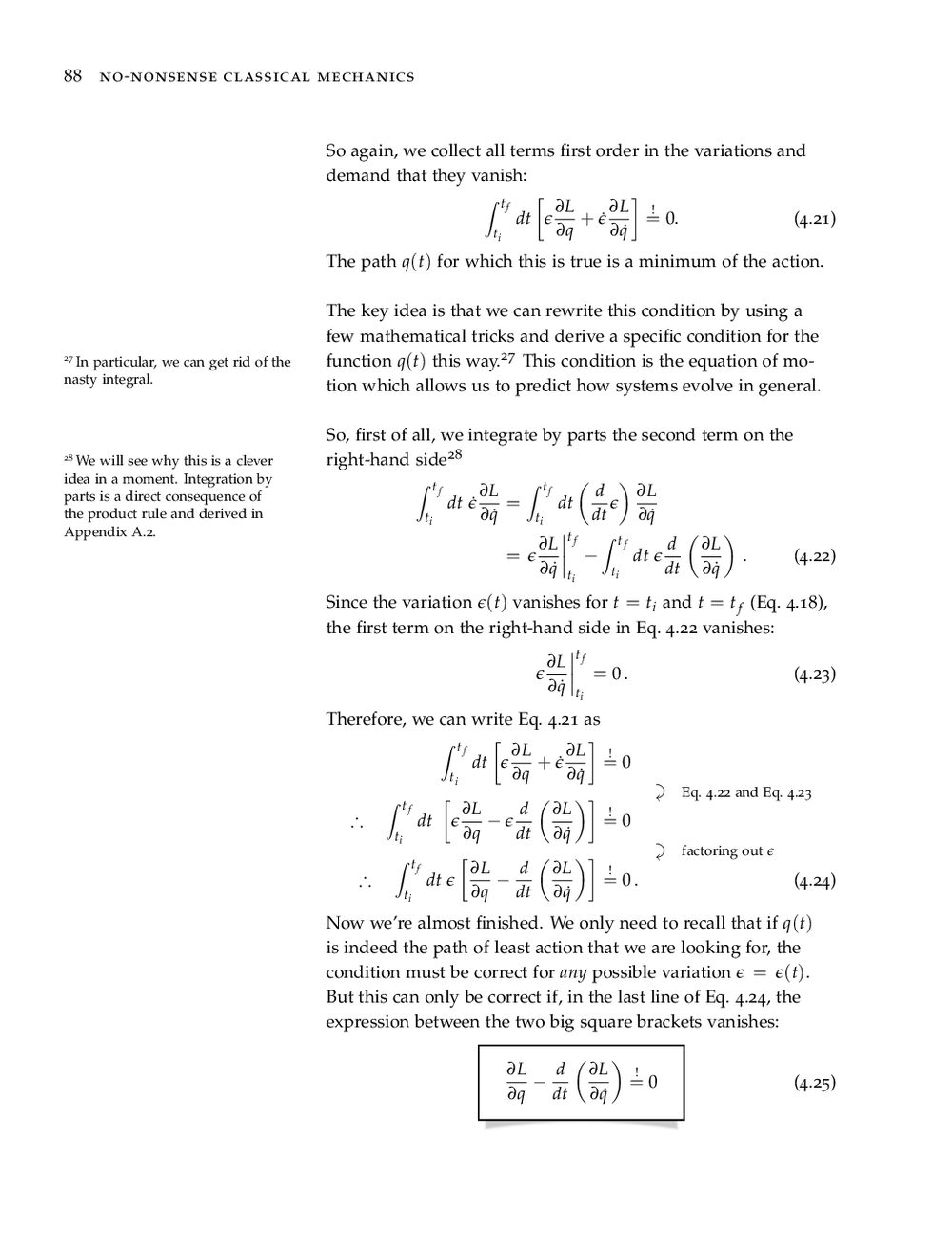
How it explains. 553 calculation steps carry a margin note saying what was done. 1,124 sidenotes repeat definitions where they are needed, and there are 162 figures. Seven appendices cover the mathematics, from integration by parts to the Legendre transform and Lagrange multipliers.
What it lacks. There are no end-of-chapter problems, so you need a second book for practice (Morin is the best match). It treats objects as mass points throughout, so rigid-body rotation, non-inertial frames and continuum mechanics, which take up three of Taylor's sixteen chapters, are not covered.
Pick it if you want to understand why the Lagrangian and Hamiltonian formulations work, you study without a lecturer, or you are heading for quantum mechanics and quantum field theory. A step-by-step plan is in the self-study guide.
2. Morin, Introduction to Classical Mechanics
Cambridge, 2008. 734 pages, $88. Fourteen chapters from problem-solving strategies (p1) and statics (p22) through F = ma (p51), oscillations (p101), conservation laws (p138), the Lagrangian method (p218), central forces, angular momentum and accelerating frames, to three chapters on relativity (p501, p584, p634) and one on general relativity (p649).
Its value is the problems: Cambridge lists more than 250 with detailed solutions, which makes it the best book here for someone who has to check their own work. It is also the book my own reading list recommends for the basic ideas. It has no chapter on the Hamiltonian formulation, and the explanations are tied to problems, so as a first explanation of the formal side it is less direct.
Pick it as your practice book, alongside any of the others.
3. Taylor, Classical Mechanics
University Science Books, 2005. 786 pages, $149 list. The standard intermediate course text. Its sixteen chapters run from Newton's laws (p3) through projectiles, momentum, energy and oscillations to the calculus of variations (p215) and Lagrange's equations (p237), then central forces, non-inertial frames, rigid bodies, coupled oscillators, chaos (p457), Hamiltonian mechanics (p521), collisions, special relativity (p595) and continuum mechanics (p681). The back matter gives answers to odd-numbered problems (p749).
Taylor covers far more applications than my book, including rigid bodies, chaos and continuum mechanics. What it does not do is put the formulations at the centre: the Hamiltonian chapter starts two thirds of the way in, and Noether's theorem has no heading. At twice the length and more than four times the price, it is the book to use when a course requires it. The Taylor comparison maps its chapters onto mine.
4. Kleppner and Kolenkow, An Introduction to Mechanics
Cambridge, 2nd edition 2013. 566 pages, $84. Cambridge describes it as a text for first- and second-year undergraduates with foundation skills in mathematics. Its fourteen chapters are Newtonian throughout: vectors and kinematics (p1), Newton's laws (p47), momentum, energy, angular momentum, rigid bodies, non-inertial frames, central forces (p373), the harmonic oscillator (p411) and three chapters on special relativity (p439 to p528).
It is known as a demanding first course and is excellent for building problem-solving strength in Newtonian mechanics. It is not a book to learn the Lagrangian or Hamiltonian formulation from; it has no chapter on either.
5. Susskind and Hrabovsky, The Theoretical Minimum
Basic Books, paperback 2014. 256 pages, $18.99. Based on Leonard Susskind's lectures for a general audience, and described by its publisher as a first course for the ardent amateur. It introduces the principle of least action, the Lagrangian and the Hamiltonian with real equations, which few popular books do.
It is the cheapest printed way in. It works through far fewer systems and calculations than a textbook, so it is a preview, not a replacement.
6. David Tong, Classical Dynamics lecture notes
Free PDF from Cambridge, about 130 pages, written as a second course for final-year undergraduates. Clear and compact, and they cover the Lagrangian and Hamiltonian formalisms, rigid bodies and canonical transformations.
Excellent once you know the basics. As lecture notes they show fewer intermediate steps than a self-learner needs on a first pass.
7. Goldstein, Poole and Safko, Classical Mechanics
Pearson, 3rd edition 2002 (first edition 1950). 664 pages, $279.99 list, the most expensive book here by a wide margin. The standard graduate reference. Pearson's description says it is accessible to students without an intermediate course, but in practice it moves fast and assumes mathematical maturity.
Read it after a first book. It is last on this list because it is the wrong first book, not because it is a bad one.
Three reading paths
- Self-study, aiming at quantum physics: No-Nonsense Classical Mechanics for the concepts, Morin for problems, then quantum mechanics.
- University course: your assigned text for problems and exams, plus No-Nonsense Classical Mechanics or Tong's notes when a derivation does not make sense.
- Graduate preparation: a first book, then Goldstein or Landau and Lifshitz's Mechanics.
Method
I compared seven books that are commonly recommended for classical mechanics, from a first course to graduate level. Prices are from the publishers' US pages on 2026-10-21, or Amazon's list price where the publisher showed none. Start pages come from each book's table of contents: Cambridge's front-matter PDFs for Morin and Kleppner and Kolenkow, and the archive.org scan of the 2005 printing for Taylor. The No-Nonsense figures come from the book's own table of contents and LaTeX source. Goldstein's table of contents could not be checked, so it is left out of the second table.
The ranking weights what matters to a reader who wants to understand the subject: how completely steps are explained, whether the book works without a lecturer, how directly it reaches the formulations used in the rest of physics, and price. A student facing a specific exam should weight the assigned text higher.
Questions
Which classical mechanics book is best for beginners?
For a first course with understanding as the goal, No-Nonsense Classical Mechanics plus Morin for practice. For a strong student who wants a hard Newtonian course first, Kleppner and Kolenkow.
Is Goldstein good for self-study?
Not as a first book. It assumes you have seen the material before and has no worked solutions in the text.
Which book covers the Hamiltonian formulation best?
Of the books with checked tables of contents, No-Nonsense Classical Mechanics gives it the most room relative to its length: Chapters 5, 7.3, 8.3, 9.3 and 10.3 all treat it. Taylor has one chapter on it, near the end.