No-Nonsense Quantum Mechanics is my book (Jakob Schwichtenberg). Griffiths and Schroeter's chapter pages are from Cambridge's front-matter PDF of the 3rd edition; price from Cambridge's US page. Checked 2026-10-21.
Griffiths and Schroeter's Introduction to Quantum Mechanics (Cambridge, 3rd edition 2018, 508 pages, $80) is the usual first course text, and my own book's reading list recommends it as written in the same physics-first spirit. It teaches you to calculate early: Chapter 2 solves the Schrödinger equation for standard potentials before the general formalism arrives in Chapter 3. That is efficient for a course. It also means you can solve problems before you know why the rules are what they are. No-Nonsense Quantum Mechanics (2nd edition, 266 pages, $34 as PDF eBook) starts with that question, and then covers four formulations of quantum mechanics that Griffiths does not list.
The two books in numbers
| No-Nonsense Quantum Mechanics | Griffiths and Schroeter | |
|---|---|---|
| Edition | 2nd edition (2018) | 3rd edition (2018) |
| Pages | 266 | 508 |
| US price | $34 eBook (paperback currently sold on Amazon.com only by third-party sellers) | $80.00 hardback |
| General formalism starts | Chapter 3, p47 (18%) | Chapter 3, p91 (18%) |
| Hydrogen atom | p127 (48%) | within Chapter 4, from p131 (26%) |
| Perturbation theory | p170 (64%) | p279 (55%) |
| Path integral and other formulations | p199 to p232 | no heading |
| Exercises | none; 229 annotated calculation steps | many; no solutions section in the contents |
| Style | Annotated derivations, 548 sidenotes, 104 figures | "Attractive and informal" (Cambridge) |
| Amazon rating (Oct 2026) | 4.6 from 218 ratings | check |
Griffiths' twelve chapters, and where No-Nonsense covers each
| Griffiths and Schroeter chapter (start page) | No-Nonsense Quantum Mechanics |
|---|---|
| 1 The Wave Function (p3) | Ch. 2 Essential Quantum Features (p33), 3.3 Wave Functions (p60) |
| 2 Time-Independent Schrödinger Equation (p25) | 6.1 Separating time and space (p108), Ch. 7 Box (p115), Ch. 8 Scattering off a Box (p131), Ch. 9 Harmonic oscillator (p141) |
| 3 Formalism (p91) | Ch. 3 The Quantum Framework (p47), Ch. 13 Mathematical Arenas (p187) |
| 4 Quantum Mechanics in Three Dimensions (p131) | 7.3 The Hydrogen Atom (p127), 3.9 Angular Momentum (p84), 3.10 Spin (p85), Ch. 10 Spin (p153) |
| 5 Identical Particles (p198) | not covered |
| 6 Symmetries and Conservation Laws (p232) | not covered as a chapter |
| 7 Time-Independent Perturbation Theory (p279) | 12.1 Perturbation Theory (p170) |
| 8 The Variational Principle (p327) | not covered as a section |
| 9 The WKB Approximation (p354) | not covered |
| 10 Scattering (p376) | Ch. 8 Scattering off a Box (p131), one-dimensional only |
| 11 Quantum Dynamics (p402) | not covered as a chapter |
| 12 Afterword (p446) | Ch. 15 What Does It All Mean? (p233) |
What No-Nonsense covers that Griffiths and Schroeter has no heading for: the classical limit (p95), the pilot-wave formulation (p199), path integrals (p204), phase-space quantum mechanics (p219), the Heisenberg formulation (p229) and a comparison of all of them (p231).
So the trade is concrete. Griffiths covers more applications: identical particles, symmetries, the variational method, WKB, three-dimensional scattering and time-dependent problems have chapters there and not in my book. My book covers the foundations and the other formulations, which matter if you continue to quantum field theory, and does it in half the pages.
What the explanations look like
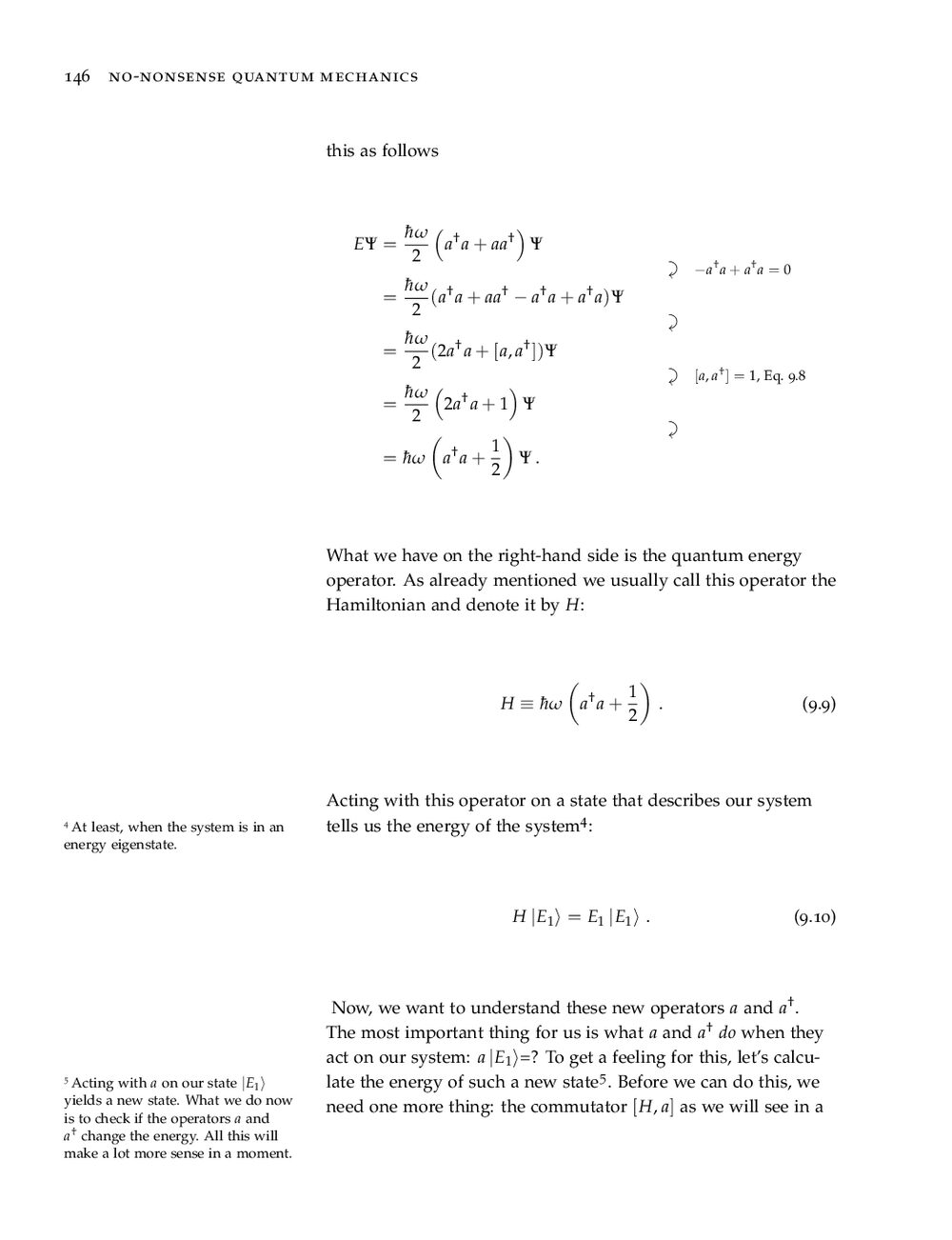
Both books solve the harmonic oscillator with ladder operators. In mine, every line of the algebra carries a note saying which identity was used:
Stuck in Griffiths? Where to look in No-Nonsense Quantum Mechanics
- What the wave function means and why it must be normalized (Griffiths Ch. 1): the statistics intermezzo and statistical tools (p51 to p59) and wave functions (p60).
- Why separation of variables works for the Schrödinger equation (Griffiths Ch. 2): Section 6.1 (p108), with why solutions must be smooth (p110) and how they are classified (p111).
- Operators, commutators and Hermitian observables (Griffiths Ch. 3): quantum operators (p66), how operators influence each other (p73), and eigenvectors and eigenvalues (p82).
- Bra-ket notation and Hilbert space (Griffiths Ch. 3): Chapter 13, Mathematical Arenas (p187 to p198).
- The ladder-operator solution of the harmonic oscillator (Griffiths Ch. 2): Chapter 9 (p141), with every step annotated (sample page below).
- Spin and spin addition (Griffiths Ch. 4): Section 3.10 (p85) and Chapter 10 (p153 to p162).
- Perturbation theory (Griffiths Ch. 7): Section 12.1 (p170).
When No-Nonsense Quantum Mechanics is the better choice
- The postulates feel arbitrary to you and you want to know where the Schrödinger equation and [x, p] = iħ come from.
- You are studying alone and need every step shown.
- You plan to continue to quantum field theory, which uses the operator formalism, the Heisenberg picture and the path integral.
- You want the shorter book: 266 pages against 508.
When to stay with Griffiths
- Your course assigns it and sets problems from it.
- You need identical particles, WKB, the variational method or time-dependent perturbation theory.
- You want many exercises in one place.
The two work well together: my Chapters 2 and 3 (p33 to p94) before Griffiths' Chapter 3, then Griffiths for problems, then my Part III before you move on to QFT.
Other alternatives
- Susskind and Friedman, Quantum Mechanics: The Theoretical Minimum (Basic Books, $21.99): lighter, starts with spin, for amateurs.
- Townsend, A Modern Approach to Quantum Mechanics ($131 list): starts from spin and state vectors.
- Shankar, Principles of Quantum Mechanics ($99 list): longer and more formal, with a path-integral chapter (p223) after a 74-page mathematics chapter.
- For problems with solutions: Galitski et al., Exploring Quantum Mechanics (700+ solved problems), or Schaum's Outline of Quantum Mechanics.
Full list: best quantum mechanics books for beginners. Study plan: quantum mechanics self-study guide.
Questions
Is Griffiths enough to learn quantum mechanics?
For a first course, yes. For quantum field theory you will also want the operator and path-integral formulations, which Griffiths does not cover.
Is No-Nonsense Quantum Mechanics mathematically rigorous?
No, and its book page says so. For rigour, Brian Hall's Quantum Theory for Mathematicians or Peter Woit's Quantum Theory, Groups and Representations.