By Jakob Schwichtenberg, author of No-Nonsense Quantum Mechanics (2nd edition, 266 pages). Page numbers refer to the current paperback; counts come from the LaTeX source.
Quantum mechanics is the subject people most often try to learn on their own, and the one where popular explanations help least. You can read a dozen books about superposition and still not be able to calculate the energy levels of a box. This guide shows how to use No-Nonsense Quantum Mechanics as the main book for self-study: what mathematics to have first, how to split the book into four stages, how to test yourself after each, and which problem books to calculate from, because mine has no exercise sets.
The two places self-learners stall
The first is the beginning. Most course books state the postulates (states are vectors, observables are operators, the Schrödinger equation gives the time evolution) and start calculating. Readers can follow the calculations without knowing why the rules look like that, and the subject feels arbitrary. No-Nonsense Quantum Mechanics spends Chapter 2 (p33 to p46) on the experimental features that force the rules on us, starting from the double-slit experiment, before the formalism appears in Chapter 3.
The second is the step from wave functions to state vectors and operators. Every book after the first course uses bra-ket notation and Hilbert space, and a reader who only knows wave functions hits a wall there. Chapter 3 introduces the general framework with state vectors first and gets wave functions from it (p60), and Chapter 13 (p187) explains the different mathematical arenas, including Hilbert space, explicitly.
The book in numbers
- 229 calculation steps annotated in the margin.
- 548 sidenotes.
- 104 figures.
- Three appendices: Taylor expansion (p249), Fourier transform (p253), delta distribution (p257).
- Five formulations of quantum mechanics covered: wave function and operators, pilot wave, path integral, phase space, and Heisenberg.
What to know before you start
- Calculus, including partial derivatives and simple differential equations.
- Complex numbers, including eiθ = cos θ + i sin θ.
- Basic linear algebra: vectors, matrices, eigenvalues. Section 3.8 (p82) reviews eigenvectors and eigenvalues, but it is a reminder, not a course.
- Helpful but not required: the Hamiltonian formulation of classical mechanics. It makes the energy operator and the commutator look familiar. See the classical mechanics guide.
Stage 1: the quantum framework (pages 25 to 106)
After the overview (p25), Chapter 2 covers the three features that make quantum mechanics different: we need waves to describe particles (p33), some quantities are quantized (p38), and quantum systems have built-in uncertainty (p43). Chapter 3 (p47) builds the framework: the statistics you need (p51 and p54), wave functions (p60), operators (p66), how operators influence each other through commutators (p73), how quantum systems change in time with the Schrödinger equation (p75), why quantum mechanics is about waves (p79), angular momentum (p84), spin (p85) and quantum numbers (p91). Chapter 4 (p95) shows how classical mechanics comes out as the average behaviour.
- What is an expectation value, and how do you compute it from a wave function?
- Why does the commutator [x, p] = iħ imply that position and momentum cannot both be sharp?
- Where does the Schrödinger equation come from in the book's argument, and what is the role of the energy operator?
- What does it mean that spin is "intrinsic" angular momentum?
Stage 2: standard systems (pages 107 to 186)
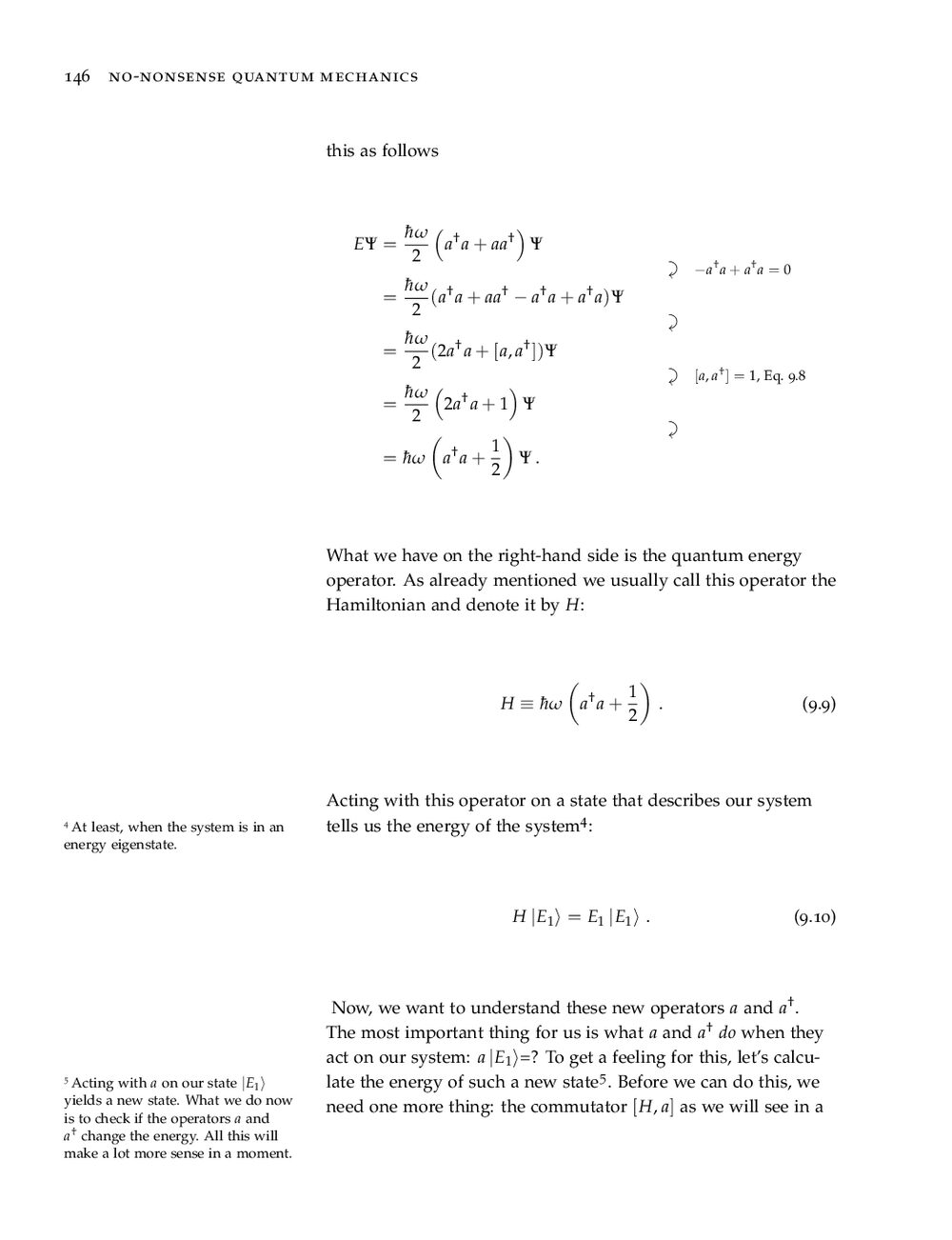
Chapter 6 (p107) collects the tricks used in every problem: separating time and space (p108), why wave functions are smooth (p110), and how solutions are classified (p111). Then come the systems: the infinite box (p115), the finite box (p121), the hydrogen atom (p127), scattering off a step (p134) and a box (p138), which is where tunneling appears, the harmonic oscillator with ladder operators (p141 and p144), spin measurements and spin addition (p155 and p161), further systems (p163), and perturbation theory (p170).
This is the stage for practice problems. Work at least the box, the harmonic oscillator and one spin problem in a problem book before moving on.
- Find the energy levels of a particle in an infinite box.
- Explain why a particle can be found inside a barrier higher than its energy.
- Derive the energy spectrum of the harmonic oscillator with ladder operators.
- Compute the first-order energy shift for a small perturbation of the box potential.
Stage 3: beyond wave functions (pages 187 to 232)
This is the part I called "What your professor is not telling you about quantum mechanics". Chapter 13 (p187) explains the mathematical arenas: physical space, configuration space, phase space and Hilbert space. Chapter 14 (p199) presents four further formulations: pilot wave (p199), path integrals (p204), phase-space quantum mechanics (p219) and the Heisenberg picture (p229), and compares them (p231).
If quantum field theory is your goal, the path integral section is required reading; it is the formulation QFT uses most. The Heisenberg picture is the starting point of canonical quantization of fields.
- In the path integral formulation, how is the amplitude to go from A to B computed?
- What changes between the Schrödinger and Heisenberg pictures, and what stays the same?
- Why is phase-space quantum mechanics harder to set up than classical phase-space mechanics?
Stage 4: interpretations (pages 233 to 248)
Chapter 15 (p233) discusses what quantum mechanics means. I put it last on purpose: the calculations do not depend on the interpretation, and the debate makes more sense once you know the formalism. Chapter 16 (p241) is the reading list.
Problem books with full solutions
The book recommends two problem books at the end, and for a self-learner they are the most useful companions because they include worked solutions:
- Galitski, Karnakov, Kogan and Galitski Jr., Exploring Quantum Mechanics: A Collection of 700+ Solved Problems. Large and comprehensive.
- Schaum's Outline of Quantum Mechanics by Peleg, Pnini, Zaarur and Hecht. Shorter and closer to a first course.
- Griffiths and Schroeter, Introduction to Quantum Mechanics (Cambridge, $80), if you want a course text with many problems. See Griffiths compared.
After the book
- A second explanation in the same physics-first spirit: Feynman Lectures on Physics, Volume 3.
- To see how wave functions behave: Bernd Thaller, Visual Quantum Mechanics, or Brandt and Dahmen, The Picture Book of Quantum Mechanics.
- For the formal side: Asher Peres, Quantum Theory: Concepts and Methods, or Leslie Ballentine, Quantum Mechanics: A Modern Development.
- Graduate level: Sakurai and Napolitano, Modern Quantum Mechanics (Cambridge, $91).
- Next subject: quantum field theory.
The full comparison is on best quantum mechanics books for beginners.
Common questions
Can I learn quantum mechanics without a physics degree?
Yes, with the mathematics listed above. The book is written for physics students and for readers outside physics who want more than the popular-science version.
Do I need to understand interpretations before I can calculate?
No. That is why they are in Chapter 15, after the formalism and the systems.
Which parts can I skip if I only want the standard first course?
Stages 1 and 2 (p25 to p186) cover what a typical first course covers. Stage 3 is what prepares you for quantum field theory and for the foundations debate; skip it only if neither interests you.