By Jakob Schwichtenberg, author of No-Nonsense Classical Mechanics. Taylor's chapter pages come from the archive.org scan of the 2005 printing; price and page count from Amazon (University Science Books' site was unreachable). Checked 2026-10-21.
John R. Taylor's Classical Mechanics is the standard intermediate course text: 786 pages, sixteen chapters, $149 list. People look for an alternative for three reasons: the price, the length, or because they worked through it and still do not feel they understand the Lagrangian and Hamiltonian formulations. No-Nonsense Classical Mechanics (393 pages, $34) answers the third reason directly and the first two as a side effect. It is not a replacement for everything Taylor covers, and the chapter map below shows exactly where it is not.
The two books in numbers
| No-Nonsense Classical Mechanics | Taylor, Classical Mechanics | |
|---|---|---|
| Publisher, year | No-Nonsense Books, 2019 | University Science Books, 2005 |
| Pages | 393 | 786 |
| US price | $34 eBook or paperback | $149.00 list |
| Chapters | 13 plus 7 appendices | 16 |
| Lagrangian formulation starts | p67 (17% into the book) | p237 (30%) |
| Hamiltonian formulation starts | p93 (24%) | p521 (66%) |
| Noether's theorem | Chapter 10, p223 | no heading ("More about Conservation Laws", p268) |
| Exercises | none; 553 annotated calculation steps | chapter problems, answers to odd-numbered ones (p749) |
| Written for | Students, self-learners, lecturers | Students who have taken an introductory mechanics course |
| Amazon rating (Oct 2026) | 4.8 from 271 ratings | check |
Taylor's sixteen chapters, and where No-Nonsense covers each
| Taylor chapter (start page) | No-Nonsense Classical Mechanics |
|---|---|
| 1 Newton's Laws of Motion (p3) | Ch. 2 Fundamental Concepts (p25), Ch. 3 Newtonian Mechanics (p59) |
| 2 Projectiles and Charged Particles (p43) | not covered as a topic |
| 3 Momentum and Angular Momentum (p83) | 2.1 Basic Quantities (p26); conservation from symmetry in Ch. 10 (p223) |
| 4 Energy (p105) | 2.1 Basic Quantities (p26) |
| 5 Oscillations (p161) | Ch. 8 The Harmonic Oscillator (p181), in all three formulations |
| 6 Calculus of Variations (p215) | 4.2 Variational Calculus (p81) |
| 7 Lagrange's Equations (p237) | Ch. 4 Lagrangian Mechanics (p67), 7.2 The Lagrangian Algorithm (p127), Appendix C Lagrange Multipliers (p359) |
| 8 Two-Body Central-Force Problems (p293) | not covered |
| 9 Mechanics in Noninertial Frames (p327) | not covered |
| 10 Rotational Motion of Rigid Bodies (p367) | not covered |
| 11 Coupled Oscillators and Normal Modes (p417) | not covered |
| 12 Nonlinear Mechanics and Chaos (p457) | the full, nonlinear pendulum in Ch. 9 (p201); no chaos |
| 13 Hamiltonian Mechanics (p521) | Ch. 5 Hamiltonian Mechanics (p93), 7.3 The Hamiltonian Algorithm (p148), canonical transformations (p196) |
| 14 Collision Theory (p557) | not covered |
| 15 Special Relativity (p595) | 12.1 The Cube of Physics (p297) and 12.3, as the origin of the classical Lagrangian |
| 16 Continuum Mechanics (p681) | not covered |
And what No-Nonsense covers that Taylor has no heading for: Noether's theorem in both formalisms (p223 to p250), Hamilton-Jacobi mechanics (p252), statistical mechanics from Liouville's theorem (p261), Koopman-von Neumann mechanics (p287), and where the least-action principle and the form L = T − V come from (p300 and p311).
The pattern is clear. Taylor is broad: seven of its chapters cover applied topics my book does not, and two more (chaos, relativity) get only partial counterparts. My book is deep on the formal structure: it reaches the Hamiltonian formulation at 24% instead of 66%, and it spends its second half on symmetry, alternative formulations and the connection to modern physics.
The same derivation in both books
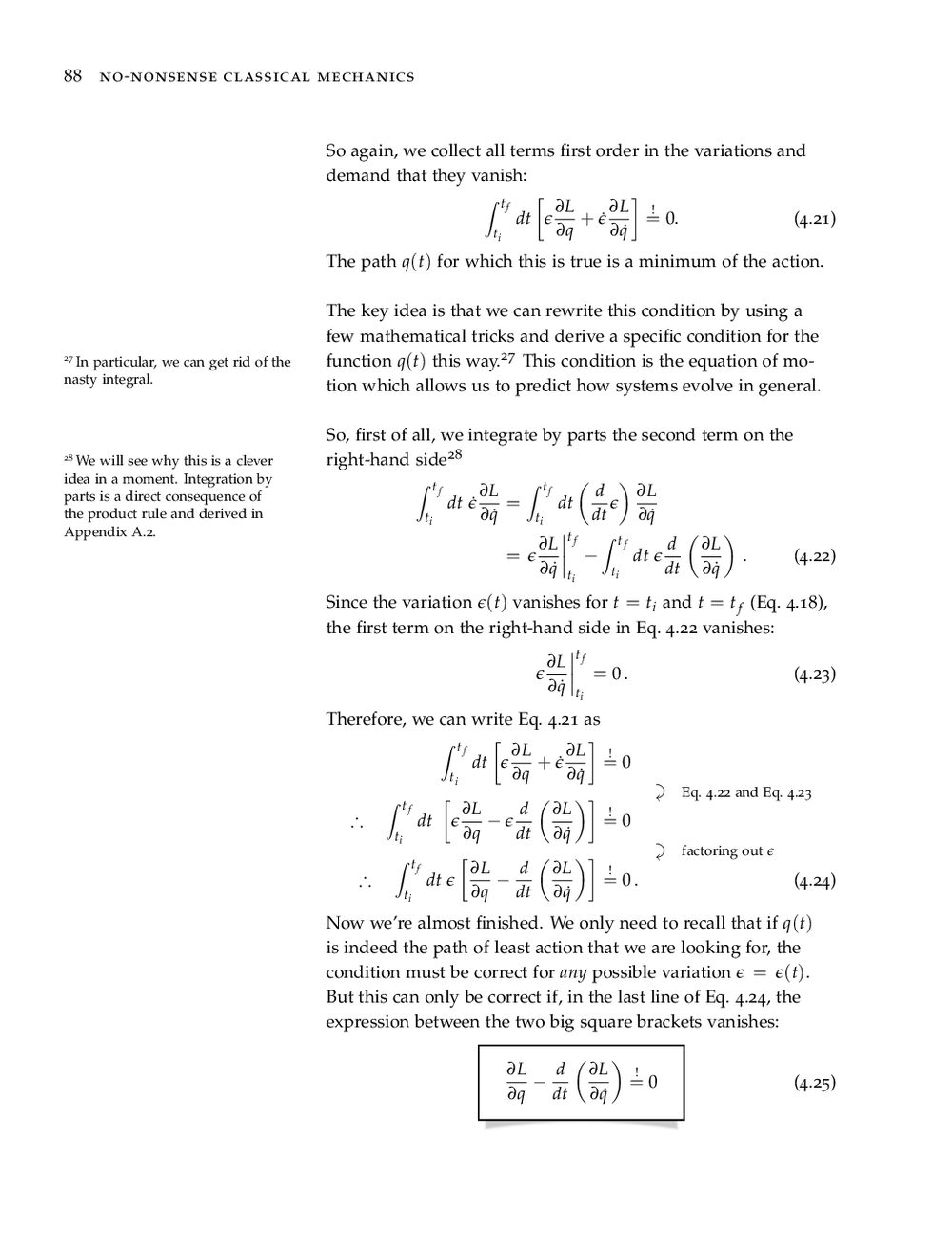
Both books derive the Euler-Lagrange equation from the calculus of variations. Taylor gives the calculus of variations its own chapter (p215) and applies it to examples such as the shortest path and the brachistochrone before turning to mechanics in Chapter 7. My book introduces the action first, with the idea that nature picks the path of least action (p73), develops just the variational calculus needed (p81) and then derives the Euler-Lagrange equation (p86). Every step of that derivation carries a margin note:
When No-Nonsense Classical Mechanics is the better choice
- You want to understand the Lagrangian and Hamiltonian formulations and how they relate to Newton's laws, not only how to apply them.
- You are studying alone and need every step shown.
- You are heading for quantum mechanics or quantum field theory. The Hamiltonian, the Poisson bracket and Noether's theorem are the parts of mechanics those subjects reuse, and my book reaches all three in its first 60%.
- Price: $34 against a $149 list price.
When Taylor is the better choice
- Your course assigns Taylor and sets homework from it.
- You need central forces, rigid bodies, non-inertial frames, coupled oscillators, chaos or continuum mechanics.
- You want practice problems with answers in the same book.
Using both
Read Taylor's Chapters 1 to 5 for Newtonian mechanics and practice. Before Taylor's Chapter 6, read Chapters 4 and 5 of No-Nonsense Classical Mechanics (p67 to p112) to see the Lagrangian and Hamiltonian formulations together, then return to Taylor for problems in Chapters 6, 7 and 13. Read my Chapter 10 on Noether's theorem after Taylor's Chapter 7.
Stuck in Taylor? Where to look in No-Nonsense Classical Mechanics
- Calculus of variations (Taylor Ch. 6): why a stationary action gives an equation of motion is built up from the "nature is lazy" idea on p67 to p80, the variational calculus itself on p81 to p85, and the Euler-Lagrange equation on p86 to p92.
- Generalized coordinates and constraints (Taylor Ch. 7): the Lagrangian algorithm with worked choices of coordinates (p127 to p147), the pendulum in Cartesian and polar coordinates (p207), and Lagrange multipliers (Appendix C, p359).
- Why Hamilton's equations, and what the Legendre transform does (Taylor Ch. 13): Chapter 5 (p93 to p112) and Appendix B (p351).
- Conservation laws (Taylor Ch. 7): Noether's theorem, first intuitively (p228), then in the Hamiltonian (p232) and Lagrangian (p242) formalisms.
- Phase-space orbits (Taylor Ch. 13): the mathematical arenas in Section 2.3 (p49), and Liouville's theorem in the statistical mechanics section (p261).
- Calculus steps you lost track of: Appendix A on the product rule, integration by parts, total and partial derivatives and the chain rule (p343 to p350).
Other alternatives to Taylor
- Morin, Introduction to Classical Mechanics (Cambridge, 734 pages, $88): more than 250 problems with detailed solutions; Lagrangian method in Chapter 6 (p218), no Hamiltonian chapter.
- Kleppner and Kolenkow (Cambridge, 566 pages, $84): a harder Newtonian first course, no Lagrangian chapter.
- David Tong's Classical Dynamics notes: free, about 130 pages, final-year level.
All are compared on best classical mechanics textbooks, and the study plan for my book is in the self-study guide.
Questions
Is Taylor's Classical Mechanics good for self-study?
It is clearly written and has answers to the odd-numbered problems, which helps. Its weakness for self-study is the length and the late Hamiltonian chapter, not the quality.
Does No-Nonsense Classical Mechanics cover everything in Taylor?
No. Of Taylor's sixteen chapters, seven have no counterpart in my book and two only a partial one (see the table). It covers the formal core in more depth and adds topics Taylor does not have.