By Jakob Schwichtenberg, author of No-Nonsense Electrodynamics (310 pages). Every calculation step below is annotated on the right in the style of the book; page numbers match the current paperback and eBook.
Together with the Lorentz force law $\mathbf{F} = q(\mathbf{E} + \mathbf{v}\times\mathbf{B})$—which tells charges how to move in given fields—Maxwell's four equations are the complete classical theory of electricity, magnetism, optics, and radio waves. Every time students find electrodynamics intimidating, the culprit is almost never the physics: it is that divergence ($\nabla\cdot$) and curl ($\nabla\times$) were introduced as dry coordinate formulas rather than geometric pictures.
1. Two geometric words that unlock all four equations
Before reading a single equation (this is why Appendix A of No-Nonsense Electrodynamics spends 70 pages, p227–p296, on visual vector calculus), keep two physical readings in mind:
- Divergence $\nabla\cdot\mathbf{F}$ at a point = net outflow ("faucet strength") per unit volume. Positive divergence means field lines sprout outward from that point; negative divergence means they drain inward; zero divergence means every field line entering a tiny box also leaves it. By Gauss's theorem (p278), integrating $\nabla\cdot\mathbf{F}$ over a volume equals the total flux $\oint_{\partial V} \mathbf{F}\cdot d\mathbf{A}$ poking through its boundary surface.
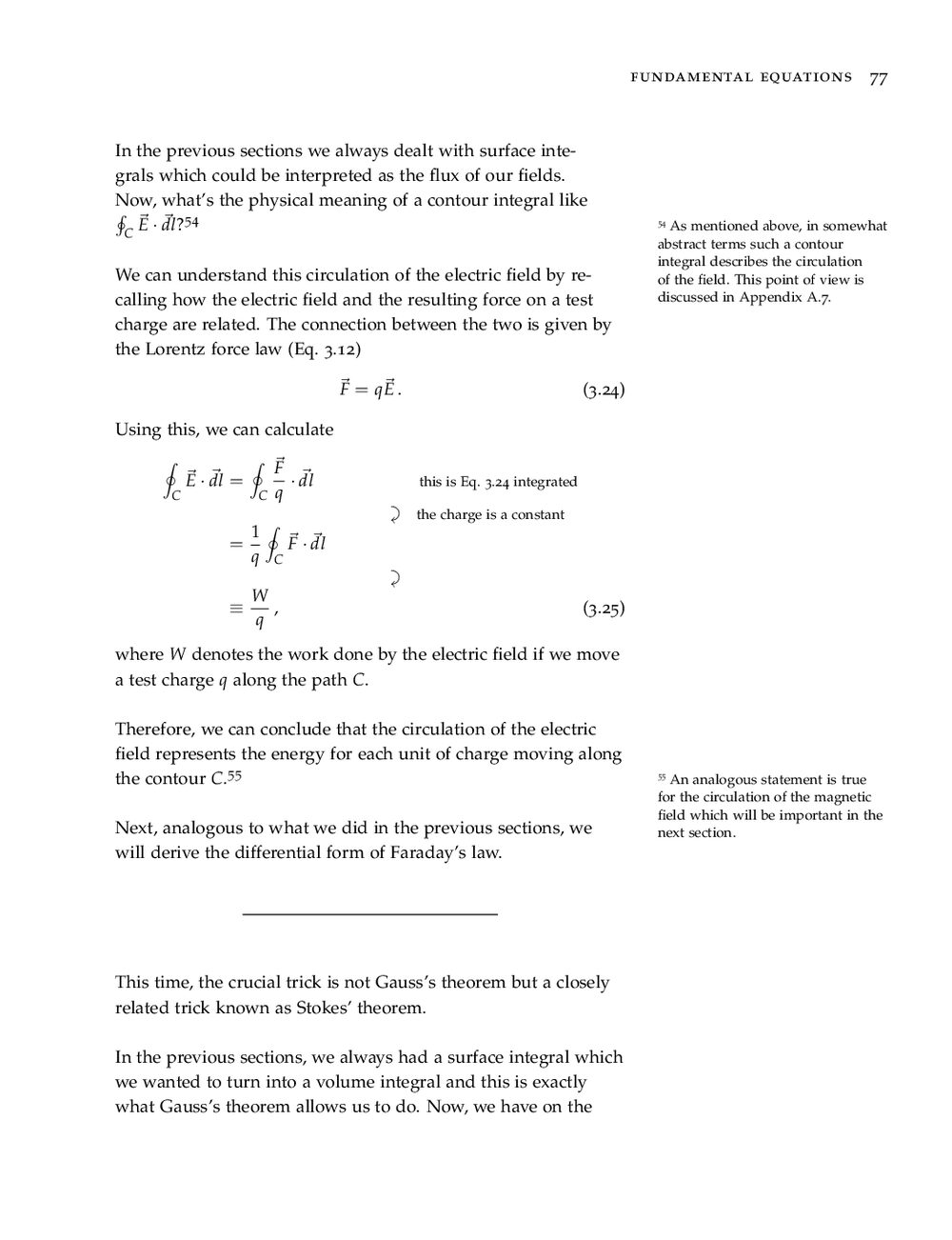
- Curl $\nabla\times\mathbf{F}$ at a point = local swirl ("paddlewheel torque") per unit area. Put a microscopic paddlewheel at $\mathbf{x}$; if the field pushes harder on one side than the other so the wheel spins, $\nabla\times\mathbf{F} \neq \mathbf{0}$ points along the rotation axis. By Stokes' theorem (p281), integrating $\nabla\times\mathbf{F}$ over an open surface $S$ equals the circulation $\oint_{\partial S} \mathbf{F}\cdot d\mathbf{l}$ around its boundary loop.
2. All four Maxwell equations side by side (SI units)
| Law (Book ref.) | Differential (pointwise) | Integral (global) | Plain-English meaning |
|---|---|---|---|
| 1. Gauss's law (Sec. 3.3, p61) |
$\nabla \cdot \mathbf{E} = \dfrac{\rho}{\varepsilon_0}$ | $\displaystyle\oint_{\partial V} \mathbf{E}\cdot d\mathbf{A} = \frac{Q_{\text{enc}}}{\varepsilon_0}$ | Electric charges are sources ($\rho>0$) and sinks ($\rho<0$) of $\mathbf{E}$; total electric flux out of any closed surface counts the enclosed charge. |
| 2. Gauss's law for $\mathbf{B}$ (Sec. 3.4, p69) |
$\nabla \cdot \mathbf{B} = 0$ | $\displaystyle\oint_{\partial V} \mathbf{B}\cdot d\mathbf{A} = 0$ | There are no magnetic monopoles: magnetic field lines never start or end—they always form closed loops (or extend to infinity). |
| 3. Faraday's law (Sec. 3.5, p74) |
$\nabla \times \mathbf{E} = -\dfrac{\partial \mathbf{B}}{\partial t}$ | $\displaystyle\oint_{\partial S} \mathbf{E}\cdot d\mathbf{l} = -\frac{d}{dt}\int_S \mathbf{B}\cdot d\mathbf{A}$ | A time-changing magnetic field curls an electric field around itself (how every power-plant generator and transformer induces voltage). |
| 4. Ampère–Maxwell law (Sec. 3.6, p79) |
$\nabla \times \mathbf{B} = \mu_0\mathbf{J} + \mu_0\varepsilon_0\dfrac{\partial \mathbf{E}}{\partial t}$ | $\displaystyle\oint_{\partial S} \mathbf{B}\cdot d\mathbf{l} = \mu_0 I_{\text{enc}} + \mu_0\varepsilon_0\frac{d}{dt}\int_S \mathbf{E}\cdot d\mathbf{A}$ | Both moving electric charges ($\mathbf{J}$) and time-changing electric fields ($\partial_t\mathbf{E}$) curl a magnetic field around themselves. |
3. Annotated proof: why Ampère's law must have Maxwell's extra term
Before Maxwell, experiments on steady wires gave $\nabla\times\mathbf{B} = \mu_0\mathbf{J}$. Maxwell noticed a fatal mathematical contradiction with charge conservation $\frac{\partial\rho}{\partial t} + \nabla\cdot\mathbf{J} = 0$ (Section 3.1, p54 and Section 3.6, p79 of No-Nonsense Electrodynamics)—and fixed it purely on paper:
4. Annotated derivation: from Maxwell's equations to light waves
Once Maxwell added $\mu_0\varepsilon_0\partial_t\mathbf{E}$, a breathtaking consequence fell out in empty space ($\rho = 0$ and $\mathbf{J} = \mathbf{0}$): a changing $\mathbf{B}$ creates a curling $\mathbf{E}$ (Faraday), which in turn creates a curling $\mathbf{B}$ (Maxwell), propelling an electromagnetic wave through vacuum without wires or charges! Here is the complete 5-step derivation (Section 3.7, p82 of No-Nonsense Electrodynamics):
5. Deeper unity: special relativity and $U(1)$ gauge symmetry
Notice something extraordinary about $c = 1/\sqrt{\mu_0\varepsilon_0}$: Maxwell's equations never ask "speed $c$ relative to whom?" That clash with Galilean velocity addition led Einstein directly to special relativity (Chapter 6, p163 of No-Nonsense Electrodynamics). When you pack $\mathbf{E}$ and $\mathbf{B}$ into the antisymmetric field tensor $F^{\mu\nu} = \partial^\mu A^\nu - \partial^\nu A^\mu$ built from the four-potential $A^\mu = (\phi/c, \mathbf{A})$ (index notation in Appendix A.11, p290), all four Maxwell equations collapse into two manifestly Lorentz-covariant equations:
$$\partial_\mu F^{\mu\nu} = \mu_0 J^\nu \qquad \text{and} \qquad \partial_\lambda F_{\mu\nu} + \partial_\mu F_{\nu\lambda} + \partial_\nu F_{\lambda\mu} = 0.$$Better still, changing $A_\mu \to A_\mu + \partial_\mu\chi(x)$ leaves $F^{\mu\nu}$ completely unchanged—the prototype gauge symmetry (Chapters 7–8, p175–p218) on which the entire Standard Model of particle physics is modeled in quantum field theory!
Common questions
Which is more fundamental: the differential form or the integral form?
In smooth media they are mathematically equivalent via Gauss's and Stokes' theorems. Across sharp boundaries between two materials (like glass and air), the integral form gives you the jump conditions cleanly; in relativistic field theory and QFT, the local differential / tensor form $\partial_\mu F^{\mu\nu} = \mu_0 J^\nu$ (derived from $\mathcal{L} = -\frac{1}{4\mu_0}F_{\mu\nu}F^{\mu\nu} - J^\mu A_\mu$ via the Euler–Lagrange equation) is primary because physics is local.
What would change if a magnetic monopole were discovered?
Gauss's law for magnetism would acquire a magnetic charge density $\rho_m$, and Faraday's law would acquire a magnetic current term $-\mathbf{J}_m$, making Maxwell's equations completely symmetric under electric–magnetic duality $(\mathbf{E}, c\mathbf{B}) \to (c\mathbf{B}, -\mathbf{E})$.
Do I need a separate vector-calculus textbook before learning electrodynamics?
Not if you use No-Nonsense Electrodynamics: its 70-page Appendix A builds scalars, vectors, line/surface integrals, div, grad, curl, Gauss's theorem, Stokes' theorem, and index notation from scratch with 187 figures across the book. See also our electrodynamics self-study plan and comparison with Griffiths.
Table of Contents (PDF) · Also by Jakob: Physics from Finance ($7.99 — intuitive gauge theories) · Related guides: Euler–Lagrange equation · Feynman diagrams.