Jakob Schwichtenberg wrote No-Nonsense Electrodynamics. Griffiths' chapter pages are from Cambridge's front-matter PDF of the 5th edition; price from Cambridge's US page. Checked 2026-10-21.
David J. Griffiths' Introduction to Electrodynamics is a standard junior and senior undergraduate text, now in its 5th edition (Cambridge, 2023, 650 pages, $72). I recommend it myself in the reading list of my book. The reason to look for an alternative is usually not quality but order: Griffiths builds the subject the way it was discovered, from electrostatics to magnetostatics to the full Maxwell equations, and saves relativity for the last chapter. No-Nonsense Electrodynamics (310 pages, $34) states all four equations in its first quarter, explains what each one says, and spends its last third on relativity and gauge symmetry.
The two books in numbers
| No-Nonsense Electrodynamics | Griffiths, Introduction to Electrodynamics | |
|---|---|---|
| Edition, publisher | 2018, No-Nonsense Books | 5th edition 2023, Cambridge University Press |
| Pages | 310 | 650 |
| US price | $34 eBook or paperback | $72.00 hardback |
| Vector calculus | Appendix A, 70 pages (p227 to p296) | Chapter 1, 56 pages (p1 to p56) |
| All four Maxwell's equations by | p79 (25%) | Chapter 7, p298 (46%) |
| Gauge transformations | Chapter 7, p175 (56%) | Section 10.1.2, p445 (68%) |
| Special relativity | Chapter 6, p163 (53%) | Chapter 12, p508 (78%) |
| Exercises | none; 221 annotated calculation steps | many; no solutions section in the contents |
| Audience | Students, self-learners, lecturers | Junior and senior undergraduates in physics and electrical engineering |
Griffiths' twelve chapters, and where No-Nonsense covers each
| Griffiths chapter (start page) | No-Nonsense Electrodynamics |
|---|---|
| 1 Vector Analysis (p1) | Appendix A Vector Calculus (p227 to p296) |
| 2 Electrostatics (p57) | 3.3 Gauss's law for the electric field (p61), 4.1 Electrostatic Systems (p101) |
| 3 Potentials (p113) | 2.5 The electromagnetic potential (p48), Ch. 4 (p95) |
| 4 Electric Fields in Matter (p166) | not covered |
| 5 Magnetostatics (p209) | 3.4 Gauss's law for the magnetic field (p69), 4.2 Magnetostatic Systems (p123) |
| 6 Magnetic Fields in Matter (p268) | not covered |
| 7 Electrodynamics (p298) | 3.5 Faraday's law (p74), 3.6 The Ampère-Maxwell law (p79) |
| 8 Conservation Laws (p362) | charge conservation in 3.1 The continuity equation (p54); field energy and momentum not covered as a section |
| 9 Electromagnetic Waves (p390) | 3.7 The wave equations (p82), Ch. 5 Electrodynamics (p133 to p162) |
| 10 Potentials and Fields (p442) | 2.5 (p48), Ch. 7 Gauge Symmetry (p175) |
| 11 Radiation (p472) | not covered |
| 12 Electrodynamics and Relativity (p508) | Ch. 6 Special Relativity (p163), 6.1 The origin of Maxwell's equations (p169) |
No-Nonsense covers what Griffiths has no chapter for: Chapter 8, Electrodynamics as a Gauge Theory (p181 to p218), with a toy gauge theory (p184), gauge dynamics (p190), gauge symmetry in physics (p203) and the mathematics of gauge symmetries (p210).
Three of Griffiths' chapters have no counterpart in my book: the two on fields in matter and the one on radiation. If you need dielectrics, magnetic materials or radiation from accelerated charges, Griffiths is the book. If you need to understand electrodynamics as the first gauge theory, the chapter that matters most in my book has no counterpart in his.
Two ways into Maxwell's equations
Griffiths reaches the full set in Chapter 7, after 297 pages in which each equation is developed in its static form first. My book introduces charge, current, field and potential (p31 to p52) and then takes the four equations one section each (p61 to p82), with the physical meaning of each term worked out. The page below is from the Faraday's law section: what the circulation of the electric field means physically, derived step by step.
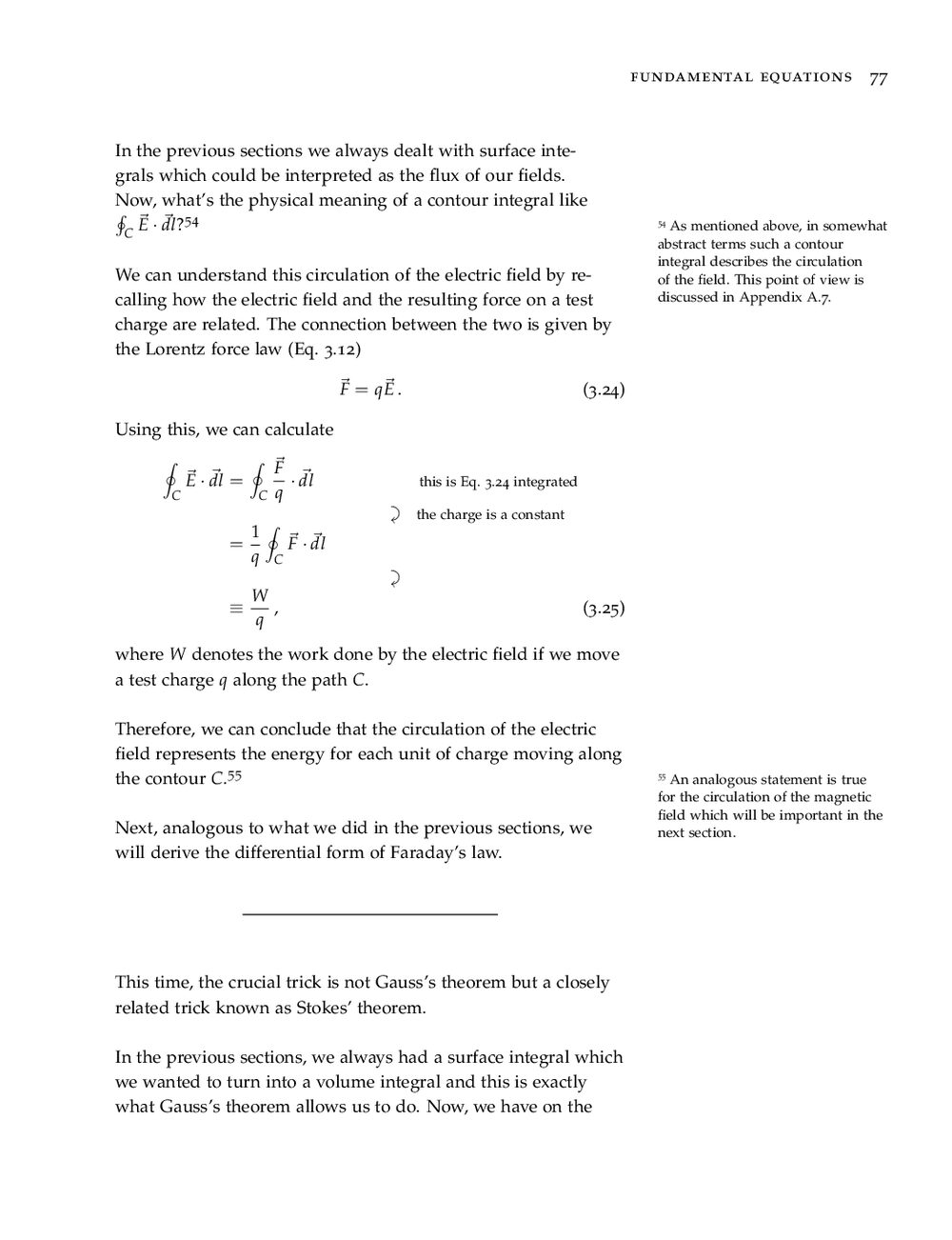
Neither order is wrong. Griffiths' order gives you practice with each piece before the whole. Mine gives you the whole first, so every later calculation has a place in it.
Choose No-Nonsense Electrodynamics if
- you want to know what each Maxwell equation says before solving boundary-value problems;
- you are heading for quantum field theory and need relativity and gauge symmetry early;
- vector calculus is new to you (the 70-page appendix teaches it from the beginning);
- you study without a lecturer.
Choose Griffiths if
- your course uses it for homework and exams;
- you need fields in matter or radiation;
- you want many standard exercises in electrostatics and magnetostatics.
Reading them together
Read Chapters 2 and 3 of my book (p31 to p94) first for the concepts and the four equations. Then work Griffiths' Chapters 2, 5 and 7 for practice. Read my Chapters 6 to 8 before or instead of Griffiths' Chapter 12. If you need matter and radiation, those come from Griffiths' Chapters 4, 6 and 11.
Stuck in Griffiths? Where to look in No-Nonsense Electrodynamics
- Divergence, curl and the integral theorems (Griffiths Ch. 1): Appendix A, with flux (p257), divergence (p264), curl (p270), Gauss's theorem (p278) and Stokes' theorem (p281), each with a boxed statement of what it measures.
- What Gauss's law actually says (Griffiths Ch. 2): Section 3.3 (p61 to p68), which goes from the flux picture to the differential form.
- Why there is a vector potential (Griffiths Ch. 5 and 10): Section 2.5 (p48) introduces the potential alongside the fields, and Chapter 7 (p175) explains the freedom in choosing it.
- The displacement current (Griffiths Ch. 7): Section 3.6 on the Ampère-Maxwell law (p79) and the continuity equation (p54) it is needed for.
- Gauge transformations, Coulomb and Lorenz gauge (Griffiths 10.1): Chapter 7 (p175) and, for what gauge freedom means physically, Chapter 8 (p181).
- The field tensor and Maxwell's equations in relativistic form (Griffiths Ch. 12): Chapter 6 (p163) and index notation in Appendix A.17 (p290).
Other alternatives to Griffiths
- Purcell and Morin, Electricity and Magnetism (Cambridge, 853 pages, $88): derives magnetism from relativity from Chapter 5 (p235) and prints solutions to its problems (Chapter 12, p586).
- Daniel Fleisch, A Student's Guide to Maxwell's Equations: short, one chapter per equation.
- David Tong's Electromagnetism notes: free, about 230 pages.
- Graduate level: Jackson (Wiley, $151.95) or Zangwill's Modern Electrodynamics.
The full ranking: best electrodynamics textbooks. A study plan for my book: electrodynamics self-study guide.
Questions
Is Griffiths' electrodynamics book too hard for self-study?
No, it is one of the more readable texts. What makes it harder alone is the lack of printed solutions and the length before the full picture appears.
Does the 5th edition change the structure?
The 5th edition's contents keep the twelve-chapter structure listed above, with relativity as the last chapter.