Written by Jakob Schwichtenberg. No-Nonsense Quantum Mechanics, at number 1, is my book. Facts on the others come from Cambridge's and Springer's pages, the books' tables of contents and Amazon, checked on 2026-10-21.
Beginners in quantum mechanics usually need two things from a book: an explanation of why the formalism looks the way it does, and enough worked calculations to use it. Most books are clearly stronger on one of the two, and the table of contents usually tells you which. A book that opens with a 74-page mathematics chapter, or one that reaches the hydrogen atom a quarter of the way in, is making a choice about what a beginner needs first. This page compares six books on those choices.
The short answer
- You want to understand why quantum mechanics works the way it does, especially on your own: No-Nonsense Quantum Mechanics, with a problem book.
- You are taking a first course or want lots of problems: Griffiths and Schroeter.
- You want a cheap, short start with real equations: Susskind and Friedman.
- You like starting from spin and state vectors: Townsend.
- You want a thorough, formal second book: Shankar.
- You are preparing for graduate courses or QFT: Sakurai and Napolitano.
The six books side by side
| Book | Publisher, edition | Pages | US price | Publisher's stated audience |
|---|---|---|---|---|
| No-Nonsense Quantum Mechanics | No-Nonsense Books, 2nd ed. 2018 | 266 | $34 eBook | Students, self-learners, lecturers |
| Griffiths and Schroeter, Introduction to Quantum Mechanics | Cambridge UP, 3rd ed. 2018 | 508 | $80.00 | Undergraduate course, "attractive and informal style" |
| Susskind and Friedman, Quantum Mechanics: The Theoretical Minimum | Basic Books, paperback 2015 | 384 | $21.99 | "A DIY introduction" |
| Townsend, A Modern Approach to Quantum Mechanics | University Science Books, 2nd ed. 2012 | 592 | $131.00 list | Upper-division course |
| Shankar, Principles of Quantum Mechanics | Springer, 2nd ed. 1994 | 694 | $99.00 list | Advanced undergraduate and graduate |
| Sakurai and Napolitano, Modern Quantum Mechanics | Cambridge UP, 3rd ed. 2020 | 566 | $91.00 | Graduate |
Townsend and Shankar: Amazon list prices; the others are publisher US prices. The No-Nonsense Quantum Mechanics paperback is currently sold on Amazon.com only by third-party sellers (October 2026); the PDF eBook is $34 on Gumroad.
Where each book reaches the key topics
Start page of the first chapter or section on each topic, from the tables of contents, with the share of the book in brackets.
| Topic | No-Nonsense | Griffiths and Schroeter | Shankar | Sakurai and Napolitano |
|---|---|---|---|---|
| Mathematics before physics | none up front; appendices p249 to p260 | Linear algebra appendix, p464 | Chapter 1, p1 to p74 | within ch. 1 |
| General formalism (operators, state space) | p47 (18%) | p91 (18%) | p115 (17%) | p1 |
| Hydrogen atom | p127 (48%) | within ch. 4, p131 (26%) | p353 (51%) | page not captured |
| Harmonic oscillator | p141 (53%) | within ch. 2, p25 to p90 | p185 (27%) | within ch. 2, p62 to p148 |
| Perturbation theory | p170 (64%) | p279 (55%) | p451 (65%) | p288 (51%) |
| Path integral | p204 (77%) | no heading | p223 (32%) | within ch. 2 |
| Interpretations | Chapter 15, p233 (88%) | Afterword, p446 (88%) | no chapter | no chapter |
What the table shows, honestly read: my book is not the fastest route to the standard systems. Griffiths reaches the three-dimensional problems including hydrogen at 26% of its length, Shankar the harmonic oscillator at 27%. No-Nonsense Quantum Mechanics gets to both around the halfway point, because it spends Chapters 2 and 3 on the experimental features that force the formalism on us and on building that formalism. In exchange it covers the path integral and three other formulations (p199 to p232), which Griffiths does not list at all, and it does so in a book half the length of Griffiths. Shankar also has a path-integral chapter, but only after 74 pages of mathematics.
1. No-Nonsense Quantum Mechanics
266 pages, 2nd edition. PDF eBook $34. 4.6 out of 5 from 218 Amazon ratings (October 2026).
How it is built. Part I: the three essential quantum features (waves, quantization, uncertainty, p33 to p46), the quantum framework (p47 to p94) from statistics and wave functions through operators, commutators, the Schrödinger equation, angular momentum and spin, and the classical limit (p95). Part II: separating time and space (p108), the infinite and finite box (p115, p121), the hydrogen atom (p127), scattering and tunneling (p131 to p140), the harmonic oscillator with ladder operators (p141), spin measurements and addition (p155, p161), and perturbation theory (p170). Part III, "What your professor is not telling you": the mathematical arenas including Hilbert space (p187), the pilot-wave (p199), path-integral (p204), phase-space (p219) and Heisenberg (p229) formulations, and interpretations (p233).
How it explains. 229 annotated calculation steps, 548 sidenotes, 104 figures, and appendices on the Taylor expansion, the Fourier transform and the delta distribution.
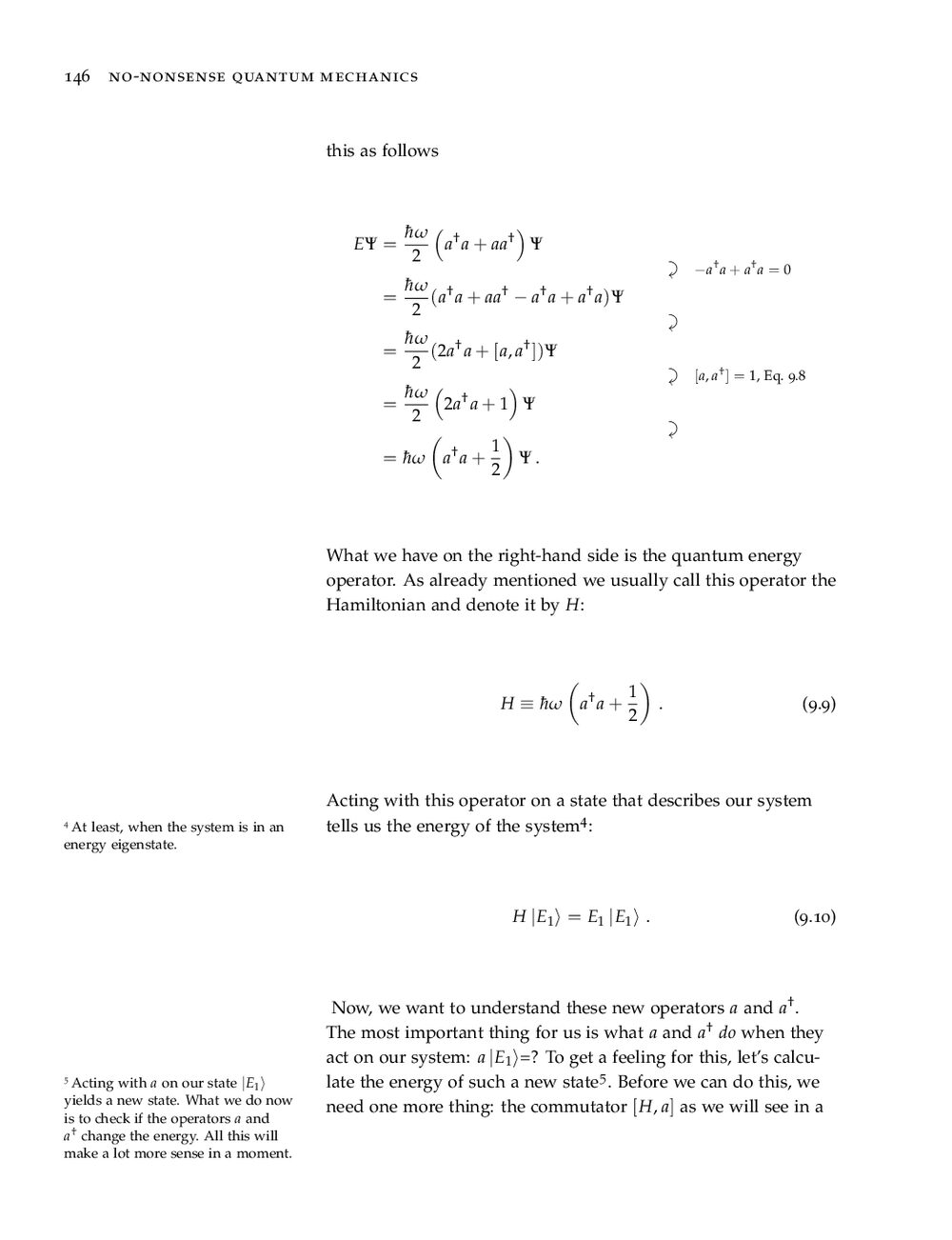
What it lacks. No exercise sets; pair it with a problem book (the book itself recommends Galitski et al.'s 700+ solved problems and Schaum's Outline). It is not mathematically rigorous, and says so on its own book page; for rigour, Brian Hall's Quantum Theory for Mathematicians is the better choice. Identical particles, the WKB approximation and time-dependent perturbation theory, which have chapters in Griffiths, get little or no room.
Pick it if the postulates have always felt arbitrary to you, you study alone, or you want to see the formulations that quantum field theory builds on. See the self-study plan.
2. Griffiths and Schroeter, Introduction to Quantum Mechanics
Cambridge, 3rd edition 2018. 508 pages, $80. The usual undergraduate course text, now co-authored with Darrell Schroeter. Part I (Theory): the wave function (p3), the time-independent Schrödinger equation (p25), formalism (p91), three dimensions (p131), identical particles (p198), symmetries and conservation laws (p232). Part II (Applications): time-independent perturbation theory (p279), the variational principle (p327), WKB (p354), scattering (p376), quantum dynamics (p402) and an afterword on interpretation (p446).
It is clear, readable and full of problems, and my own book's reading list recommends it as written in the same physics-first spirit. It starts calculating early and keeps the formal framework for Chapter 3, so readers can solve problems before they know why the rules hold. It has no heading on the path integral or other formulations. Details in the Griffiths comparison.
3. Susskind and Friedman, Quantum Mechanics: The Theoretical Minimum
Basic Books, paperback 2015. 384 pages, $21.99. Based on Leonard Susskind's lectures for a general audience; its publisher calls it a DIY introduction to the math and science of quantum mechanics. It starts with spin and two-state systems, which keeps the mathematics small, and explains states, measurement and entanglement with real equations.
The cheapest serious way in. It covers fewer systems and calculations than a course text, so it prepares you for one rather than replacing it.
4. Townsend, A Modern Approach to Quantum Mechanics
University Science Books, 2nd edition 2012. 592 pages, $131 list. Starts from spin and the Stern-Gerlach experiment instead of wave functions, so state vectors and operators come first. Its publisher positions it as the primary text for an upper-division course.
A good second book once you have seen the basics. The list price is the barrier for self-learners. Its table of contents could not be checked for this comparison.
5. Shankar, Principles of Quantum Mechanics
Springer, 2nd edition 1994. 694 pages, $99 list. Opens with a 74-page mathematical introduction (p1), reviews classical mechanics (p75), states the postulates (p115) and then works through one-dimensional problems, the harmonic oscillator (p185), the path integral (p223), symmetries, angular momentum, hydrogen (p353), spin (p373), perturbation theory (p451) and scattering (p523). Springer describes it as the requisite text for advanced undergraduates and graduate students.
Thorough and well loved as a second book. As a first book it asks a lot: the physics starts on page 115.
6. Sakurai and Napolitano, Modern Quantum Mechanics
Cambridge, 3rd edition 2020. 566 pages, $91. Eight chapters: fundamental concepts (p1), quantum dynamics (p62), angular momentum (p149), symmetry (p249), approximation methods (p288), scattering (p371), identical particles (p429) and relativistic quantum mechanics (p478). Cambridge calls it a classic graduate text.
It assumes a first course and is the natural step before quantum field theory. Last here because it is a second book, not because it is weaker.
Reading paths
- Self-study: No-Nonsense Quantum Mechanics plus Galitski et al. or Schaum's for problems, then Sakurai or QFT.
- First university course: Griffiths and Schroeter for problems, No-Nonsense Quantum Mechanics for the reasons behind the rules.
- Curious non-physicist: Susskind and Friedman first. For books with even less mathematics, see quantum physics books for non-physicists.
Method
Six commonly recommended books, from a popular-level introduction to a graduate text. Prices from Cambridge's and Basic Books' US pages, or Amazon list prices for Springer and University Science Books, on 2026-10-21. Start pages from Cambridge's front-matter PDFs (Griffiths and Schroeter, Sakurai and Napolitano) and SpringerLink's chapter list (Shankar). Townsend's and Susskind's tables of contents could not be checked and are left out of the second table. No-Nonsense figures from its own table of contents and LaTeX source.
Questions
What is the best quantum mechanics book for complete beginners?
With calculus and some linear algebra: No-Nonsense Quantum Mechanics or Griffiths and Schroeter, depending on whether you want explanation or problems first. Without that mathematics: Susskind and Friedman.
Is Shankar better than Griffiths?
Shankar is longer, more formal and includes the path integral; Griffiths is shorter, more readable and closer to a first course. If you use both, read Griffiths first.
Which quantum mechanics book prepares best for quantum field theory?
One that covers the operator formalism, the Heisenberg picture and the path integral. Of the books here, No-Nonsense Quantum Mechanics, Shankar and Sakurai all do; Griffiths has no heading on them.