By Jakob Schwichtenberg, who wrote No-Nonsense Quantum Field Theory. Peskin and Schroeder's chapter pages are from Daniel Schroeder's book page and the archive.org scan of the 1995 edition; price from Amazon. Checked 2026-10-21.
Peskin and Schroeder's An Introduction to Quantum Field Theory (1995, 864 pages, $189.99 list) has been the graduate QFT course text for three decades. Its publisher describes it as intended for the graduate course, and the structure shows it: the Klein-Gordon field arrives on page 13, Feynman diagrams on page 77, and the remaining 90% of the book is quantum electrodynamics, renormalization and non-abelian gauge theory. If you have a lecturer and solid foundations, that pace is a strength. If you are learning alone, it is usually where people get stuck. No-Nonsense Quantum Field Theory (642 pages, $34 eBook) is written for that reader.
The two books in numbers
| No-Nonsense Quantum Field Theory | Peskin and Schroeder | |
|---|---|---|
| Publisher, year | No-Nonsense Books, 2020 | Addison-Wesley 1995, now CRC Press |
| Pages | 642 | 864 |
| US price | $34 eBook, $37 paperback | $189.99 list (Amazon) |
| Pages before the first quantum field | 300 (first field on p301) | 12 (Klein-Gordon field, p13) |
| Classical field theory | Part 0, p37 to p272 | Section 2.2, p15 |
| Feynman diagrams | p441 (69%) | p77 (9%) |
| Renormalization | p493 (77%) | p211 (24%) |
| Path integral | p535 (83%) | p275 (32%) |
| Non-abelian gauge theory, QCD | no chapter | p481 onwards, about 300 pages |
| Exercises | none; 1,089 annotated calculation steps | problems at the end of chapters, three final projects |
| Amazon rating (Oct 2026) | 4.6 from 254 ratings | check |
Peskin and Schroeder's chapters, and where No-Nonsense covers each
| Peskin and Schroeder chapter (start page) | No-Nonsense Quantum Field Theory |
|---|---|
| 1 Invitation: Pair Production (p3) | Ch. 1 Bird's-Eye View (p23) |
| 2 The Klein-Gordon Field (p13) | Ch. 4 Lagrangian Formalism (p137), 5.1 Klein-Gordon equation (p170), Ch. 8 Quantum Fields (p301) |
| 3 The Dirac Field (p35) | 3.4 Spinor Fields (p94), 5.2 Dirac equation (p195), 8.7 Quantized Spinor Fields (p358) |
| 4 Interacting Fields and Feynman Diagrams (p77) | Ch. 9 Interacting Quantum Fields (p379), Ch. 10 Scattering (p407), Ch. 11 Amplitude Technology (p421) |
| 5 Elementary Processes of QED (p131) | 12.2 Gauge Interactions (p481) |
| 6 Radiative Corrections: Introduction (p175) | 13.2 Loops and Legs (p491) |
| 7 Radiative Corrections: Formal Developments (p211) | 13.4 Regularization (p493) |
| 8 Invitation: Cutoffs and Critical Fluctuations (p265) | not covered |
| 9 Functional Methods (p275) | Ch. 15 The Path Integral Formulation (p535) |
| 10 Systematics of Renormalization (p315) | 13.4 and 13.5 (p493 to p512), in less depth |
| 11 Renormalization and Symmetry (p347) | not covered |
| 12 The Renormalization Group (p393) | 13.5 The Renormalization Group (p498) |
| 13 Critical Exponents (p439) | not covered |
| 14 to 19: parton model, non-abelian gauge theory, QCD, operator products, anomalies (p473 to p688) | not covered |
| 20 and 21 Spontaneously Broken Gauge Theories (p689, p731) | Ch. 14 The Living Vacuum: symmetry breaking (p521), mass generation (p529) |
| 22 QFT at the Frontier (p781) | Ch. 17 Effective Field Models (p565), Ch. 18 Outlook (p577) |
What No-Nonsense has that Peskin and Schroeder covers in a few pages or not at all: 236 pages of preliminaries on spacetime, the four kinds of fields, the Lagrangian formalism with Noether's theorem and classical interactions (p37 to p272); a QFT-focused review of quantum mechanics (p273); instantons and non-perturbative phenomena (p553); and two appendices that work out calculations usually left as exercises (p589 to p618).
The honest summary: my book covers roughly the content of Peskin and Schroeder's Part I and the beginnings of Parts II and III, with far more explanation. It does not replace Parts II and III. Readers who need QCD, anomalies or the systematic renormalization of gauge theories go on to Peskin and Schroeder or Schwartz after it, and my book's reading list says so.
The same step in both books
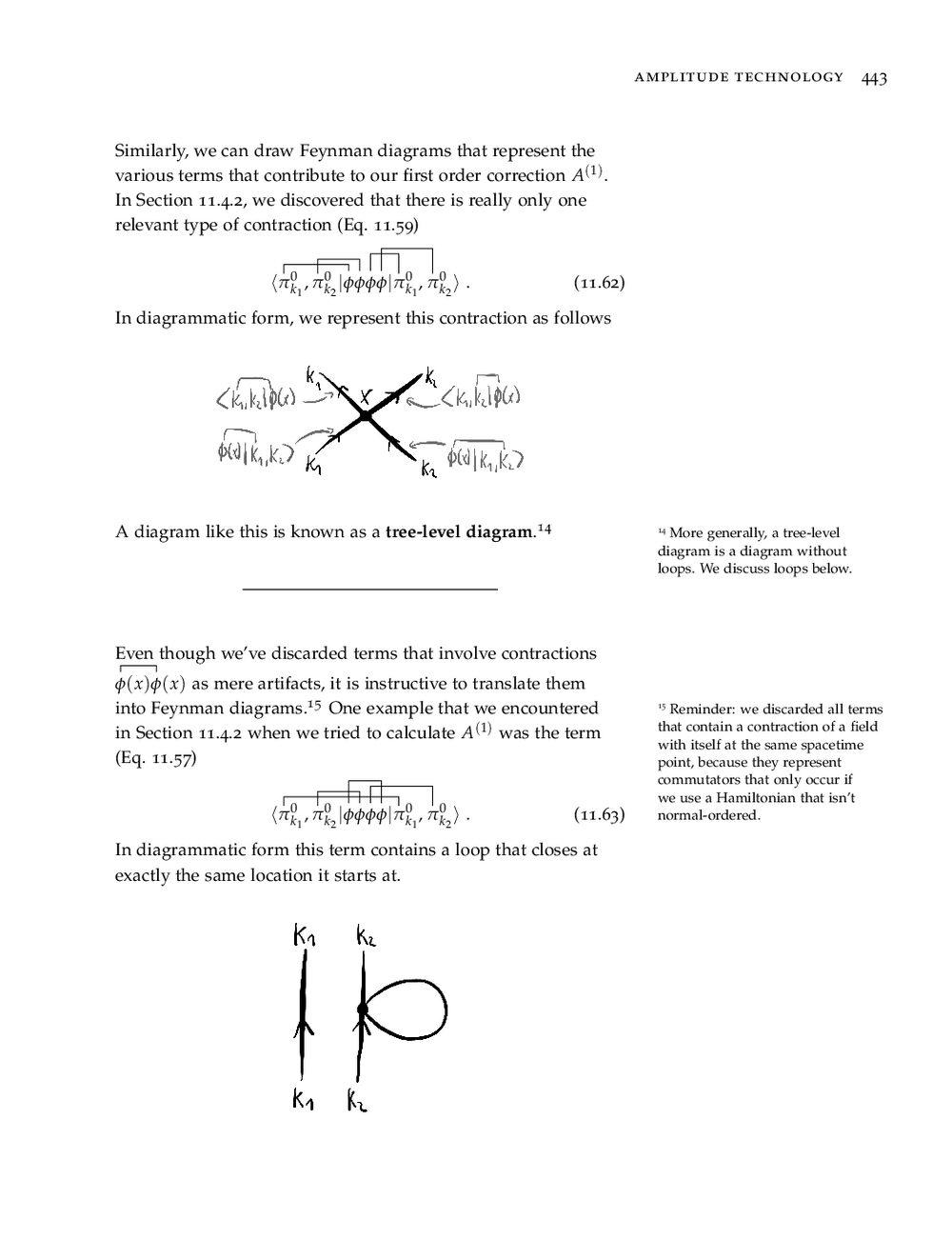
Feynman diagrams are where the difference is easiest to see. Peskin and Schroeder derive Wick's theorem and the Feynman rules within one chapter (from p77). My book does a scattering calculation by brute force first (Chapter 10, p407), so you see why the bookkeeping is needed, then introduces contractions (p423), Wick's theorem (p428) and the diagrams (p441):
Stuck in Peskin and Schroeder? Where to look in No-Nonsense Quantum Field Theory
- Index notation, the metric and Lorentz transformations (Notations and Conventions, p. xix): Chapter 2 (p37 to p68), especially four-vectors (p51) and Lorentz and Poincaré transformations (p62).
- Lagrangian and Hamiltonian field theory and Noether's theorem (Section 2.2): Chapter 4 (p137 to p166), which derives the Euler-Lagrange equation for particles first (p141) and then for fields (p153).
- Expanding the field in creation and annihilation operators (Chapter 2): field operators (p309), with the commutation relations of a(k) and a†(k) verified in full in Appendix A.4 (p595).
- Spinors and the Dirac equation (Chapter 3): what a spinor is (p80, p94), the Dirac equation (p195) and quantized spinor fields (p358).
- The propagator (Chapter 2): propagators (p334), and the proof that the Feynman propagator is a Green's function in Appendix A.7 (p601).
- Wick's theorem (Chapter 4): contractions (p423) and Wick's theorem (p428), checked by hand for three fields in Appendix B.1 (p611).
- Why loops diverge and what renormalization does (Chapters 6, 7, 10): loops (p491), regularization (p493) and the renormalization group (p498).
Which to use when
- Learning QFT on your own, or before a course: No-Nonsense Quantum Field Theory. Where to start depending on what you already know is in the self-study plan.
- Taking a course that assigns Peskin and Schroeder: use it for the problems and final projects, and No-Nonsense Quantum Field Theory when a derivation does not make sense. The chapter map above tells you which of my chapters matches each of theirs.
- After a first pass: Peskin and Schroeder, or Schwartz's Quantum Field Theory and the Standard Model (Cambridge, $104), for renormalization, gauge theories and the Standard Model in depth.
Other beginner-friendly alternatives
- Lancaster and Blundell, Quantum Field Theory for the Gifted Amateur (Oxford, 512 pages, $56).
- Klauber, Student Friendly Quantum Field Theory, which writes out every algebraic step in the canonical approach.
- David Tong's QFT notes: free, master's level, canonical quantization through QED.
All compared on best quantum field theory books for beginners.
Questions
Is Peskin and Schroeder good for self-study?
It is possible with strong foundations and a lot of persistence. Most self-learners do better reading a first book and coming to Peskin and Schroeder second, for its problems and its later parts.
What do I need before Peskin and Schroeder?
Special relativity with index notation, the Lagrangian formalism for fields, the Klein-Gordon and Dirac equations, and quantum mechanics including the harmonic oscillator with ladder operators. Part 0 of my book (p37 to p272) covers all of these except quantum mechanics.