If you teach classical mechanics, electrodynamics, quantum mechanics or quantum field theory, I am glad to send you a complimentary PDF desk copy of any No-Nonsense textbook and make it easy to use alongside your primary course text.
Request a complimentary PDF desk copy — fill in your course details below (or email jakobschwich@gmail.com directly from your institutional address with a link to your faculty or course page) and I will send the PDF(s) within 24–48 hours.
How instructors use the books in a course
The four No-Nonsense books have no end-of-chapter problem sets. Instead, every derivation in the main text is worked out line by line with margin annotations (221 to 1,089 annotated steps per book) and sidenotes that repeat definitions where they are used. Because of that design, most lecturers do not replace their homework textbook—they list the matching No-Nonsense book on the syllabus as an optional companion for conceptual overview and worked derivations.
That solves two recurring problems in intermediate and graduate physics courses:
- Office-hour bottlenecks on algebra and calculus steps: students who get lost when a standard text skips three lines of integration by parts, index gymnastics or commutator algebra can follow every intermediate step on their own.
- Textbook cost: each PDF eBook is $34 (or $99 for all four books), with paperbacks at $34–$37 on Amazon—roughly a third of standard list prices (price data).
A one-line syllabus note you can adapt:
Recommended companion for step-by-step derivations and conceptual overview: J. Schwichtenberg, No-Nonsense [Classical Mechanics / Electrodynamics / Quantum Mechanics / Quantum Field Theory] (nononsensebooks.com, $34 eBook or paperback).
Inspect the tables of contents & sample pages
| Book | Length & annotations | Table of contents | Annotated sample page |
|---|---|---|---|
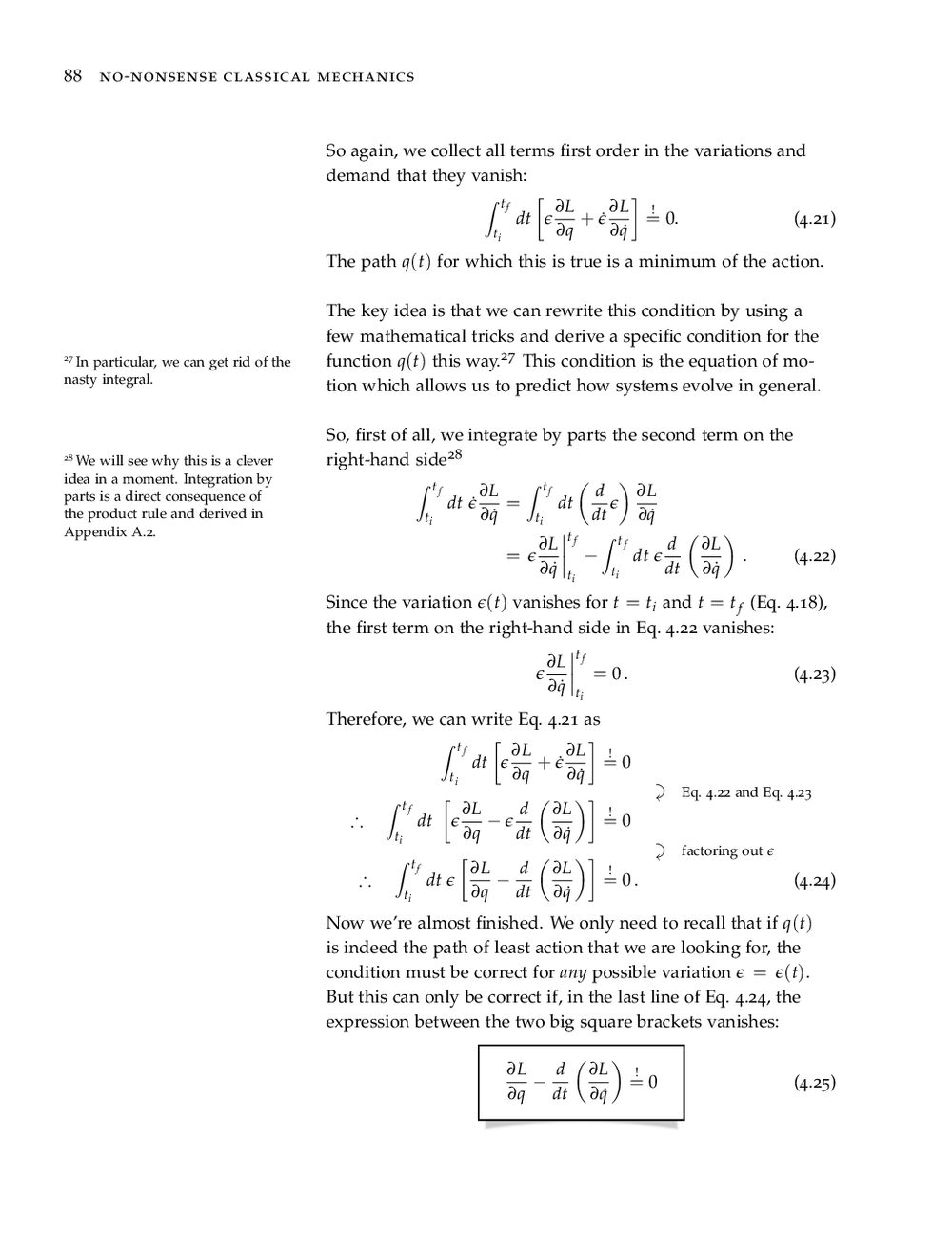
| No-Nonsense Classical Mechanics | 393 pp · 553 step notes · 1,124 sidenotes · 162 figures | TOC (PDF) | p. 88: Euler-Lagrange |
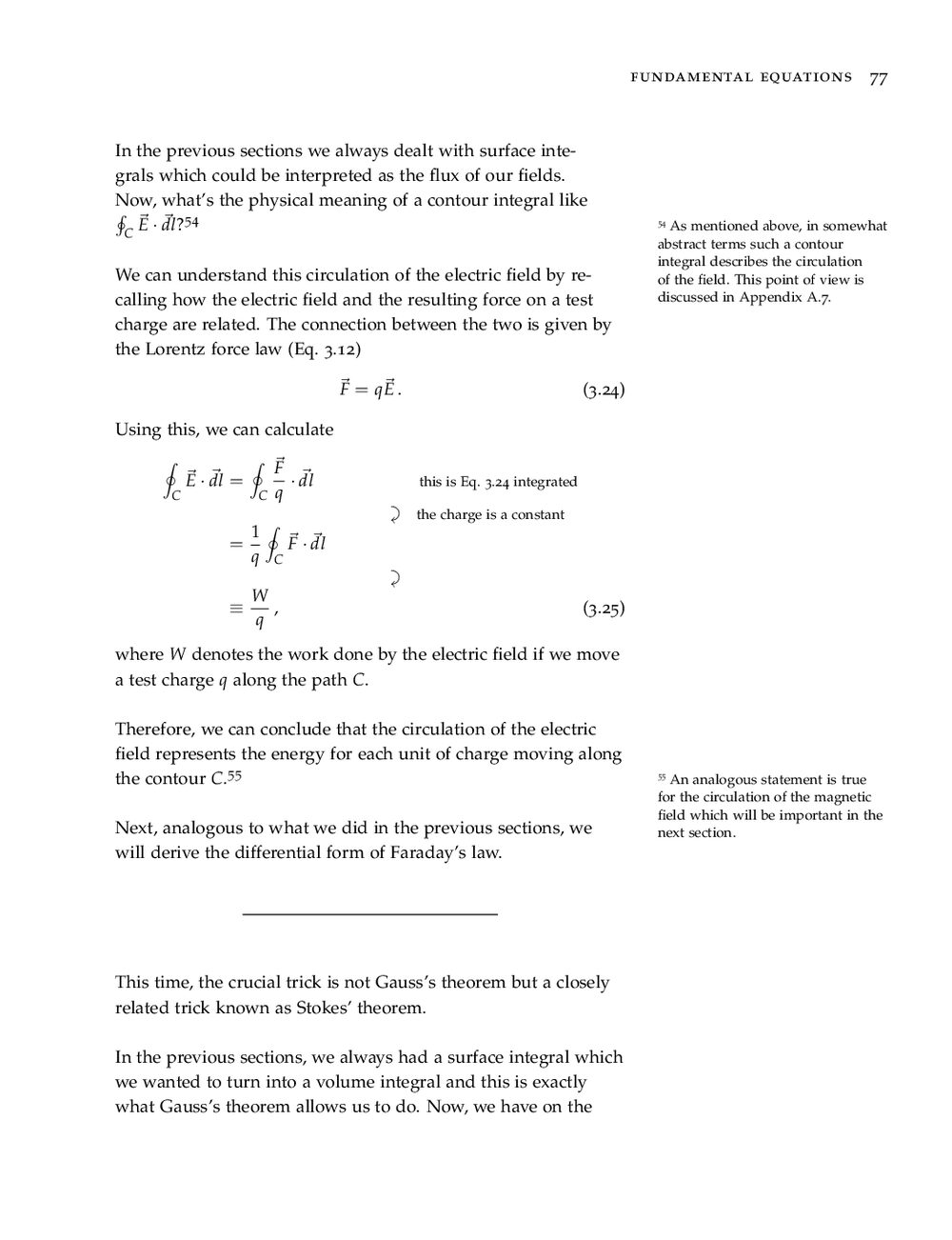
| No-Nonsense Electrodynamics | 310 pp · 221 step notes · 695 sidenotes · 187 figures | TOC (PDF) | p. 77: Faraday's law |
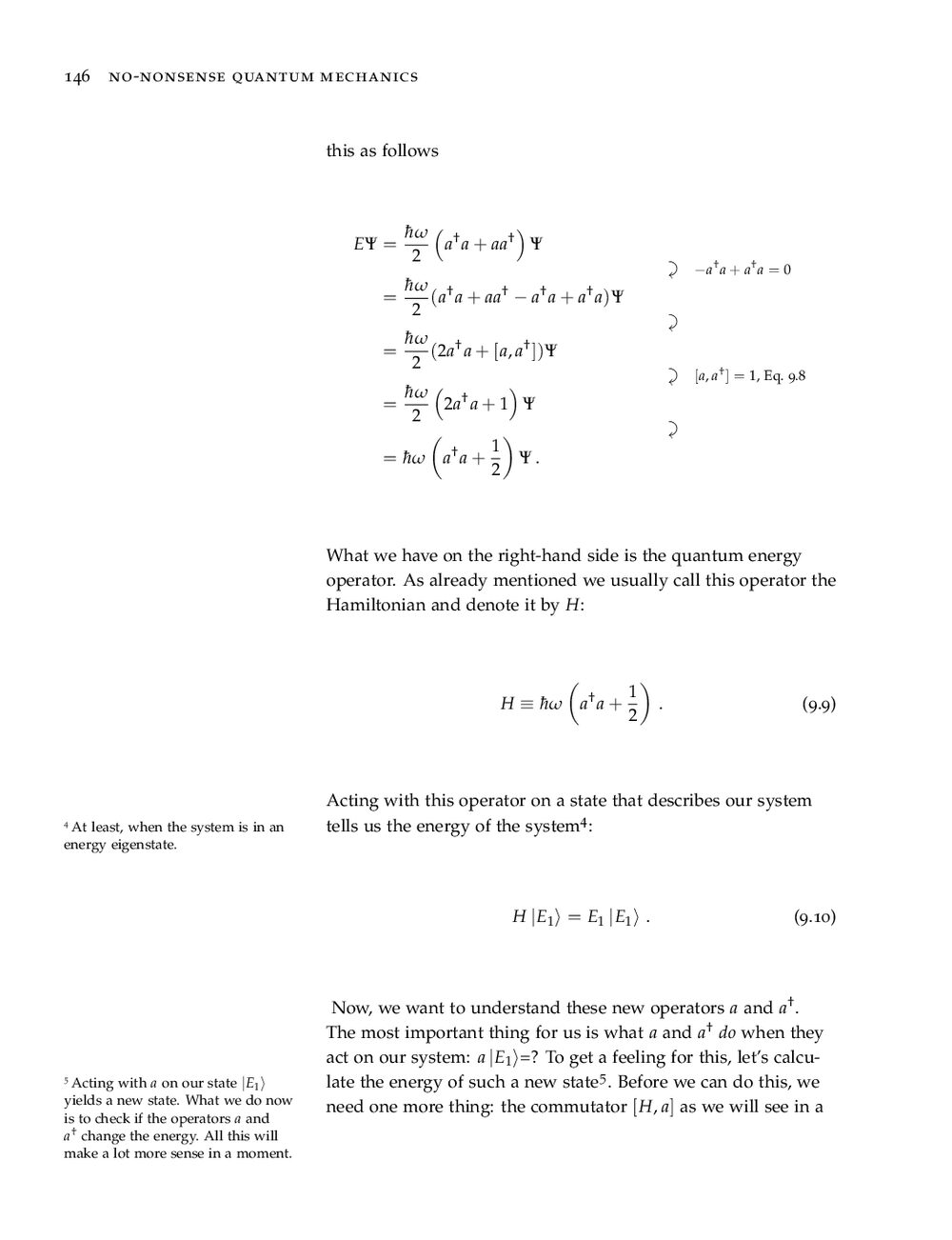
| No-Nonsense Quantum Mechanics (2nd ed.) | 266 pp · 229 step notes · 548 sidenotes · 104 figures | TOC (PDF) | p. 146: Harmonic oscillator |
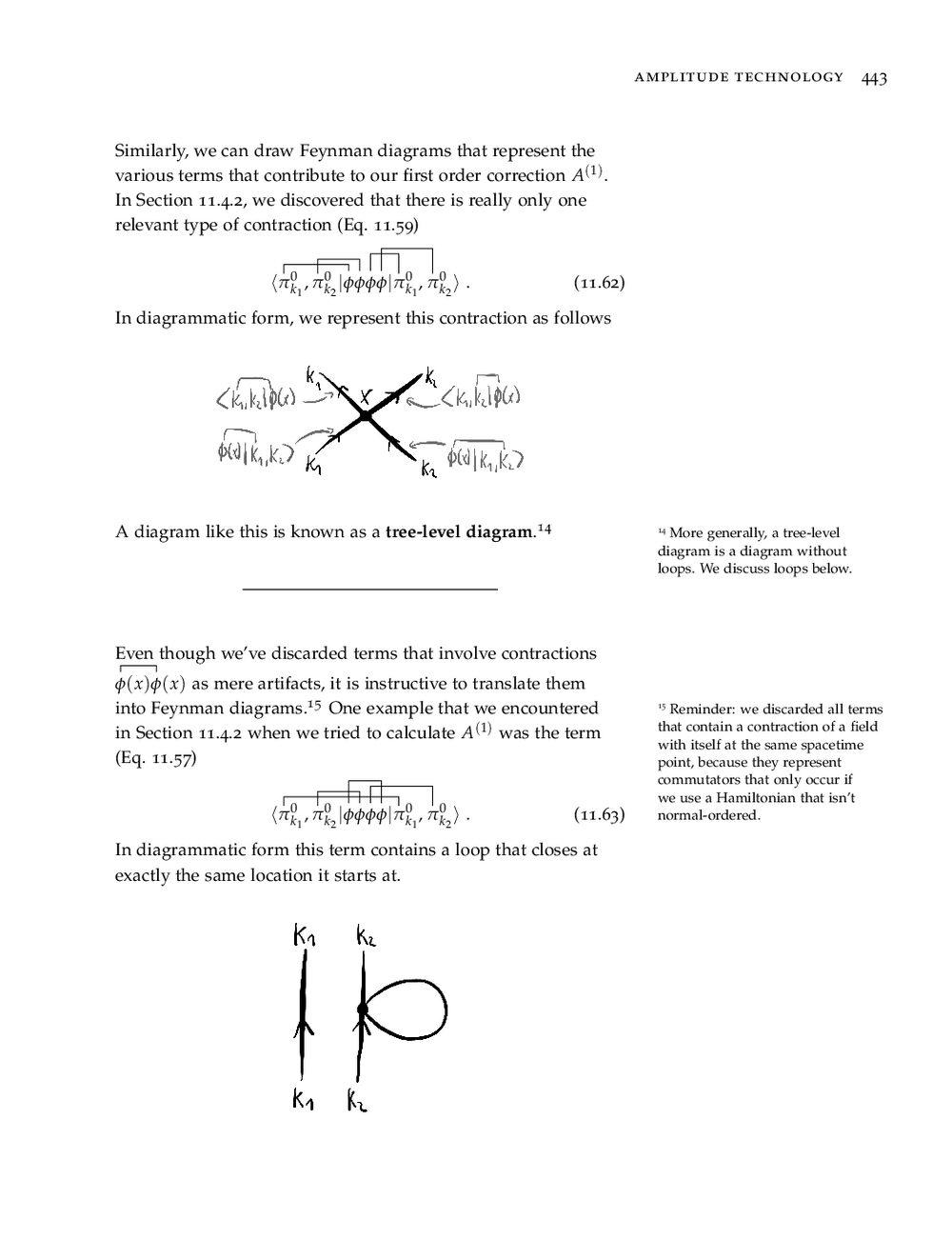
| No-Nonsense Quantum Field Theory | 642 pp · 1,089 step notes · 1,826 sidenotes · 243 figures | TOC (PDF) | p. 443: Feynman diagrams |
Free online worked exercises for students are also posted for Quantum Mechanics (Part 1, Part 2, Part 3).
Chapter-by-chapter syllabus correlation maps
Open any map below to pair weekly readings in the standard course text with the matching pages in the No-Nonsense companion:
Classical Mechanics: Taylor (2005) ↔ No-Nonsense Classical Mechanics
| Taylor chapter (start page) | No-Nonsense Classical Mechanics |
|---|---|
| Ch. 1 Newton's Laws (p3), Ch. 3–4 Momentum & Energy (p83, p105) | Ch. 2 Fundamental Concepts (p25), Ch. 3 Newtonian Mechanics (p59) |
| Ch. 5 Oscillations (p161) | Ch. 8 The Harmonic Oscillator in all 3 formulations (p181) |
| Ch. 6 Calculus of Variations (p215) | 4.2 Variational Calculus (p81–85), Euler-Lagrange derivation (p86–92) |
| Ch. 7 Lagrange's Equations (p237) | Ch. 4 Lagrangian Mechanics (p67), 7.2 Lagrangian Algorithm (p127), App. C Lagrange Multipliers (p359) |
| Conservation Laws (p268) | Ch. 10 Noether's Theorem — intuitive, Hamiltonian & Lagrangian proofs (p223–250) |
| Ch. 12 Nonlinear Mechanics (p457) | Ch. 9 Nonlinear Pendulum (p201; chaos not covered) |
| Ch. 13 Hamiltonian Mechanics (p521) | Ch. 5 Hamiltonian Mechanics & Poisson brackets (p93–112), 7.3 Hamiltonian Algorithm (p148), Canonical Transformations (p196), App. B Legendre Transform (p351) |
| Ch. 15 Special Relativity (p595) | Ch. 12 Origin of Classical Mechanics & L = T − V (p295–318) |
Full comparison: Taylor vs. No-Nonsense Classical Mechanics.
Electrodynamics: Griffiths (5th ed.) ↔ No-Nonsense Electrodynamics
| Griffiths 5e chapter (start page) | No-Nonsense Electrodynamics |
|---|---|
| Ch. 1 Vector Analysis (p1) | Appendix A Vector Calculus — physical meaning of div, curl, Gauss & Stokes (p227–296) |
| Ch. 2 Electrostatics (p57) | 3.3 Gauss's law for E (p61), 4.1 Electrostatic Systems (p101) |
| Ch. 3 Potentials (p113) | 2.5 Electromagnetic Potential (p48), Ch. 4 Static Systems (p95) |
| Ch. 5 Magnetostatics (p209) | 3.4 Gauss's law for B (p69), 4.2 Magnetostatic Systems (p123) |
| Ch. 7 Electrodynamics (p298) | 3.5 Faraday's law (p74), 3.6 Ampère-Maxwell law (p79), 3.1 Continuity equation (p54) |
| Ch. 9 Electromagnetic Waves (p390) | 3.7 Wave equations (p82), Ch. 5 Electromagnetic Waves (p133–162) |
| Ch. 10 Potentials and Fields (p442) | Ch. 7 Gauge Symmetry (p175), Ch. 8 Electrodynamics as a Gauge Theory (p181–218) |
| Ch. 12 Electrodynamics and Relativity (p508) | Ch. 6 Special Relativity & relativistic origin of Maxwell's equations (p163–174), App. A.17 Index notation (p290) |
Note: fields in matter (Griffiths Ch. 4 & 6) and radiation (Ch. 11) are not covered in No-Nonsense Electrodynamics. Full comparison: Griffiths vs. No-Nonsense Electrodynamics.
Quantum Mechanics: Griffiths & Schroeter (3rd ed.) ↔ No-Nonsense Quantum Mechanics (2nd ed.)
| Griffiths & Schroeter 3e chapter (start page) | No-Nonsense Quantum Mechanics (2nd ed.) |
|---|---|
| Ch. 1 The Wave Function (p3) | Ch. 2 Essential Quantum Features (p33), Statistics Intermezzo (p51–59), 3.3 Wave Functions (p60) |
| Ch. 2 Time-Independent Schrödinger Equation (p25) | 6.1 Separation of Variables (p108), Ch. 7 Infinite & Finite Box (p115, p121), Ch. 8 Barrier Scattering & Tunneling (p131), Ch. 9 Harmonic Oscillator via Ladder Operators (p141) |
| Ch. 3 Formalism (p91) | Ch. 3 The Quantum Framework — Operators, Commutators & Eigenvalues (p47–94), Ch. 13 Hilbert Space & Mathematical Arenas (p187–198) |
| Ch. 4 Quantum Mechanics in 3D & Spin (p131) | 7.3 Hydrogen Atom (p127), 3.9–3.10 Angular Momentum & Spin (p84–90), Ch. 10 Spin & Addition of Spin (p153–162) |
| Ch. 7 Time-Independent Perturbation Theory (p279) | 12.1 Perturbation Theory (p170) |
| Ch. 12 Afterword — Interpretations (p446) & QFT bridge | Ch. 14 Pilot-Wave, Path Integral, Phase-Space & Heisenberg Formulations (p199–232), Ch. 15 Interpretations (p233) |
Full comparison: Griffiths & Schroeter vs. No-Nonsense Quantum Mechanics.
Quantum Field Theory: Peskin & Schroeder (1995) ↔ No-Nonsense Quantum Field Theory
| Peskin & Schroeder chapter (start page) | No-Nonsense Quantum Field Theory |
|---|---|
| Notations & Ch. 1 Invitation (p3) | Ch. 1 Bird's-Eye View (p23), Ch. 2 Spacetime, Four-Vectors & Lorentz Group (p37–68) |
| Ch. 2 The Klein-Gordon Field (p13) | Ch. 4 Classical Field Lagrangians & Noether's Theorem (p137–166), 5.1 Klein-Gordon (p170), Ch. 8 Canonical Quantization & Propagators (p301–350), App. A.4 & A.7 (p595, p601) |
| Ch. 3 The Dirac Field (p35) | 3.4 Spinors (p94), 5.2 Dirac Equation (p195), 8.7 Quantized Spinor Fields (p358) |
| Ch. 4 Interacting Fields & Feynman Diagrams (p77) | Ch. 9 Interaction Picture & Dyson Series (p379), Ch. 10 Brute-Force Scattering (p407), Ch. 11 Contractions, Wick's Theorem & Feynman Diagrams (p421–464), App. B.1 (p611) |
| Ch. 5 Elementary Processes of QED (p131) | 3.5 & 6.4 Gauge Fields (p129, p264), 8.8 Quantized Gauge Fields (p367), 12.2 Gauge Interactions (p481) |
| Ch. 6, 7, 10, 12 Radiative Corrections & Renormalization (p175–393) | Ch. 13 Virtual Particles, Loops, Regularization & the Renormalization Group (p487–512) |
| Ch. 9 Functional Methods (p275) | Ch. 15 Path Integral Formulation in QM & QFT (p535–552) |
| Ch. 20 Spontaneously Broken Gauge Theories (p689) | Ch. 14 Spontaneous Symmetry Breaking & Mass Generation (p513–534) |
Full comparison: Peskin & Schroeder vs. No-Nonsense Quantum Field Theory.
Using figures in your lecture slides
Instructors are welcome to use overview diagrams and conceptual illustrations from the No-Nonsense books in university lecture slides and non-commercial course handouts at no cost. A short credit line on the slide is sufficient:
Figure from J. Schwichtenberg, No-Nonsense [Title] (nononsensebooks.com).
Course & department PDF licences (LMS / library)
Single-reader Gumroad eBooks are licensed for individual use. If your department or library wants to host the DRM-free PDF directly on Canvas, Moodle, Blackboard or an internal course portal for all enrolled students, institutional licences are available by invoice:
| Licence tier | Coverage | Annual fee (USD) |
|---|---|---|
| Single-Course PDF Licence | 1 title, up to 100 enrolled students in one course for 1 academic year (LMS upload permitted) | $299 / year |
| Department All-4-Books Licence | All 4 No-Nonsense textbooks across all undergraduate & graduate physics courses in one department for 1 academic year | $699 / year |
To set up a course or department licence by university invoice or purchase order (including German/EU VAT invoice), email jakobschwich@gmail.com with your institution, course or department name, and billing address.
Other books by Jakob Schwichtenberg for courses
- Physics from Symmetry (Springer, Undergraduate Lecture Notes in Physics, 2nd edition 2018) — already available electronically to students at most universities with a SpringerLink physics subscription (SpringerLink · Amazon).
- Physics from Finance (2019) — a short, intuitive introduction to gauge theories and fiber bundles via financial-market toy models ($7.99 eBook · Paperback).
- Teach Yourself Physics: A Travel Guide (2020) — a study roadmap for independent learners and incoming physics majors ($7.99 eBook · Paperback).