By Jakob Schwichtenberg, author of No-Nonsense Electrodynamics. Page numbers refer to the current paperback (310 pages); counts come from the book's LaTeX source.
Electrodynamics is the subject where self-learners most often discover that their real problem is mathematics. Maxwell's equations are four lines, but each line uses divergence, curl, flux or circulation, and if those are new the physics disappears behind them. This guide shows how to work through No-Nonsense Electrodynamics on your own: what to learn first, how to split the book into stages, what to check after each one, and where to find practice problems, since the book has none.
Start with the appendix, not with chapter 1
This is the one piece of advice that differs from the other guides. Appendix A, Vector Calculus, runs from page 227 to page 296. At 70 pages it is almost a quarter of the book, and I wrote it so that a reader who has never seen vector calculus can learn exactly the parts electrodynamics needs. It covers scalars, vectors and tensors (p233), line integrals (p244), circulation integrals (p253), surface and flux integrals (p254 and p257), gradient (p262), divergence (p264) and curl (p270), Gauss's theorem (p278), Stokes' theorem (p281), vector identities (p284), and index notation for Maxwell's equations (p290).
If you already know these, skim it. If you do not, read it before Chapter 3. For each operation the appendix gives the formula and then a boxed statement of what it measures: the divergence as the flux entering or leaving a point, the curl as the circulation at a point. Those physical readings are the version you need for Maxwell's equations.
Check yourself before Chapter 3:
- What does a positive divergence at a point tell you about a vector field there?
- State Gauss's theorem and Stokes' theorem in words.
- Compute the curl of the field (−y, x, 0) and describe what the result means.
The book in numbers
- 221 calculation steps annotated in the margin.
- 695 sidenotes.
- 187 figures, the most of any No-Nonsense book relative to its length.
- Three appendices: vector calculus (70 pages), Taylor expansion and the delta distribution.
Stage 1: concepts and the four equations (pages 19 to 94)
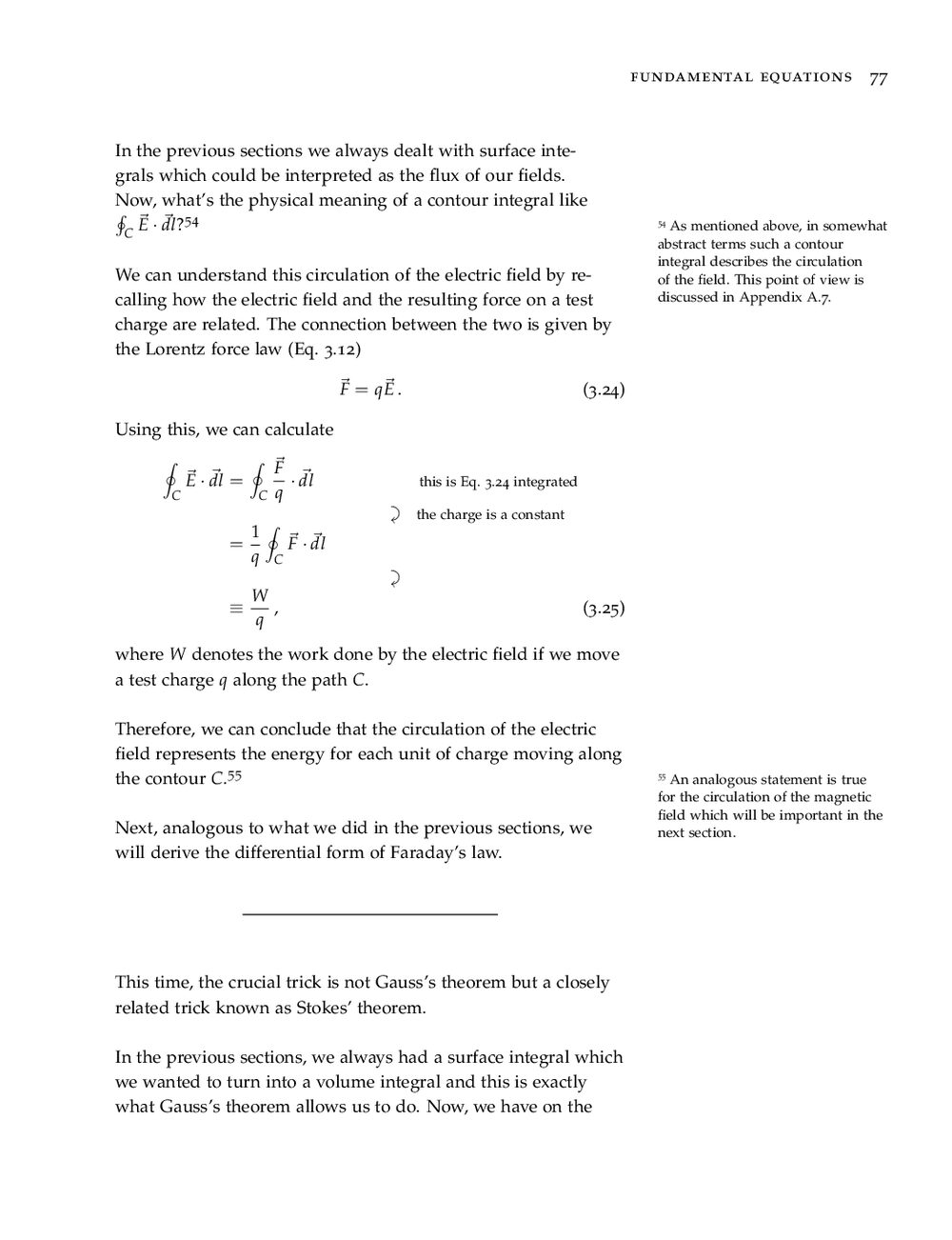
After the overview (p19), Chapter 2 (p31) introduces the objects: electric charge (p32), charge density (p35), current and current density (p37), the electromagnetic field (p42) and the electromagnetic potential (p48). Chapter 3 (p53) then takes the equations one at a time: the continuity equation (p54), the Lorentz force law (p57), Gauss's law for the electric field (p61) and for the magnetic field (p69), Faraday's law (p74), the Ampère-Maxwell law (p79), and the wave equations that follow from them (p82).
The aim of this stage is to know what each equation says in words, not to solve hard problems with it yet.
- Write each of Maxwell's equations and say in one sentence what it states physically.
- Why would Ampère's law without Maxwell's extra term contradict the continuity equation?
- Derive the wave equation for the electric field in empty space from Maxwell's equations.
Stage 2: static fields and waves (pages 95 to 162)
Chapter 4 (p95) treats fields that do not change in time: electrostatic systems (p101) and magnetostatic systems (p123). Chapter 5 (p133) treats changing fields, mostly electromagnetic waves: an explicit solution of the wave equation (p134), the matching magnetic solution (p136), general solutions (p138), basic properties (p143) and advanced properties (p149), which is where the constant speed of light appears.
Start practice problems here.
- Use Gauss's law to find the field of a uniformly charged sphere, inside and outside.
- Find the magnetic field around a long straight wire.
- Show that the electric and magnetic fields of a plane wave are perpendicular to each other and to the direction of travel.
Stage 3: relativity and gauge symmetry (pages 163 to 218)
This part is what separates the book from a typical course text, and it is the preparation for quantum field theory. Chapter 6 (p163) shows how special relativity follows from the speed of electromagnetic waves and then turns the logic around to derive Maxwell's equations (Section 6.1, p169). Chapter 7 (p175) introduces gauge symmetry, the freedom to change the potential without changing the fields. Chapter 8 (p181) explains electrodynamics as a gauge theory with a toy model (p184), gauge dynamics (p190), gauge symmetry in physics (p203) and the mathematics behind it (p210).
- What is a gauge transformation of the electromagnetic potential, and why does it leave the electric and magnetic fields unchanged?
- Why is the speed of light the same in every inertial frame, according to Maxwell's equations?
- In the toy model of Chapter 8, what role does the gauge field play?
If your goal is engineering or applied physics, you can stop after Stage 2. If your goal is quantum field theory, Stage 3 is the most important part of the book.
Problem sources to pair with the book
- David J. Griffiths, Introduction to Electrodynamics (Cambridge, 5th edition, 650 pages, $72). Many exercises at undergraduate level, and one of the books recommended at the end of mine. See Griffiths compared.
- Daniel Fleisch, A Student's Guide to Maxwell's Equations. Short, with one chapter per equation; useful alongside Chapter 3.
- H. M. Schey, Div, Grad, Curl, and All That. Problems on vector calculus, if Appendix A was new to you.
After the book
- Feynman Lectures on Physics, Volume 2: a second explanation of most topics.
- Purcell and Morin, Electricity and Magnetism (Cambridge, $88), which derives magnetism from relativity at an introductory level.
- Graduate level: Andrew Zangwill, Modern Electrodynamics, or John David Jackson, Classical Electrodynamics (Wiley, $151.95).
- Next subject: quantum mechanics, then quantum field theory.
The full comparison is on best electrodynamics textbooks.
Common questions
Should I learn electrodynamics before quantum mechanics?
Quantum mechanics does not strictly need it. Quantum field theory does: fields, gauge symmetry and special relativity all come from here. I recommend electrodynamics first if QFT is your goal.
Is Jackson suitable for self-study?
Jackson is a graduate text that assumes a full undergraduate course and strong mathematical methods. Reach it after a first book.
Does the book use SI units?
Yes, until Chapter 7, which switches to natural units with c = 1 to keep the gauge-theory chapters readable.