By Jakob Schwichtenberg. I wrote No-Nonsense Classical Mechanics, so this guide uses it as the main book. Page numbers refer to the current paperback (393 pages). The counts below come from the book's LaTeX source.
When people ask me which classical mechanics book to use without a course, they usually have one of two goals. Some want to finally understand the Lagrangian and Hamiltonian formulations they skipped or crammed at university. Others are working towards quantum mechanics and quantum field theory on their own and know that both are written in the language of classical mechanics. This guide is for both groups. It splits No-Nonsense Classical Mechanics into four stages, says what you should be able to do after each one, and names the problem books to work from, because my book has no exercise sets.
What a self-study book has to replace
In a course you get three things besides the textbook: a lecturer who fills gaps, tutorials where someone checks your reasoning, and problem sets that force you to calculate. Alone, you only have the books. That puts two demands on the main text. It must not skip steps, because nobody can explain the skipped step to you. And it must say why each new idea is introduced, because nobody tells you which parts matter.
That is what I tried to do in No-Nonsense Classical Mechanics. In numbers:
- 553 calculation steps carry a margin note that explains the step ("integrating by parts", "initial condition x(0) = 0", "cos(0) = 1").
- 1,124 sidenotes repeat definitions and earlier results at the point where you need them, so you rarely have to flip back.
- 162 figures, including overview diagrams that put the Newtonian, Lagrangian and Hamiltonian formulations side by side.
- Seven appendices on the mathematics the book uses: calculus, the Legendre transform, Lagrange multipliers, invariance and covariance, active and passive transformations, the Taylor expansion and vector calculus.
What to know before you start
- Derivatives and integrals of one variable, and partial derivatives. Appendix A (p343) reviews the product rule, integration by parts, total and partial derivatives and the chain rule. If those four pages feel new, work through a calculus book first.
- Vectors with dot and cross products. Appendix G (p381) covers both.
- A first idea of force, momentum and energy from school physics.
You do not need differential equations beyond recognising that x'' = −ω²x has sine and cosine solutions. The book solves the equations it needs as it goes.
Stage 1: overview and fundamental concepts (pages 17 to 58)
Chapter 1 (p17) is a bird's-eye view of the whole subject. Read it quickly and do not worry about details; every idea in it comes back later. Chapter 2 (p25) sets up the vocabulary: position, velocity, momentum, energy, equations of motion, and the three mathematical arenas (physical space, configuration space, phase space) in Section 2.3 (p49). The arenas matter more than they look. Each of the three formulations of mechanics lives in one of them, and the distinction comes back in quantum mechanics.
You are ready to move on when you can answer:
- What is a point in configuration space, and what is a point in phase space, for a single particle moving in one dimension?
- Why does an equation of motion have infinitely many solutions, and what picks out one of them?
- What is the difference between kinetic and potential energy, and when is total energy conserved?
Stage 2: the three formulations (pages 59 to 120)
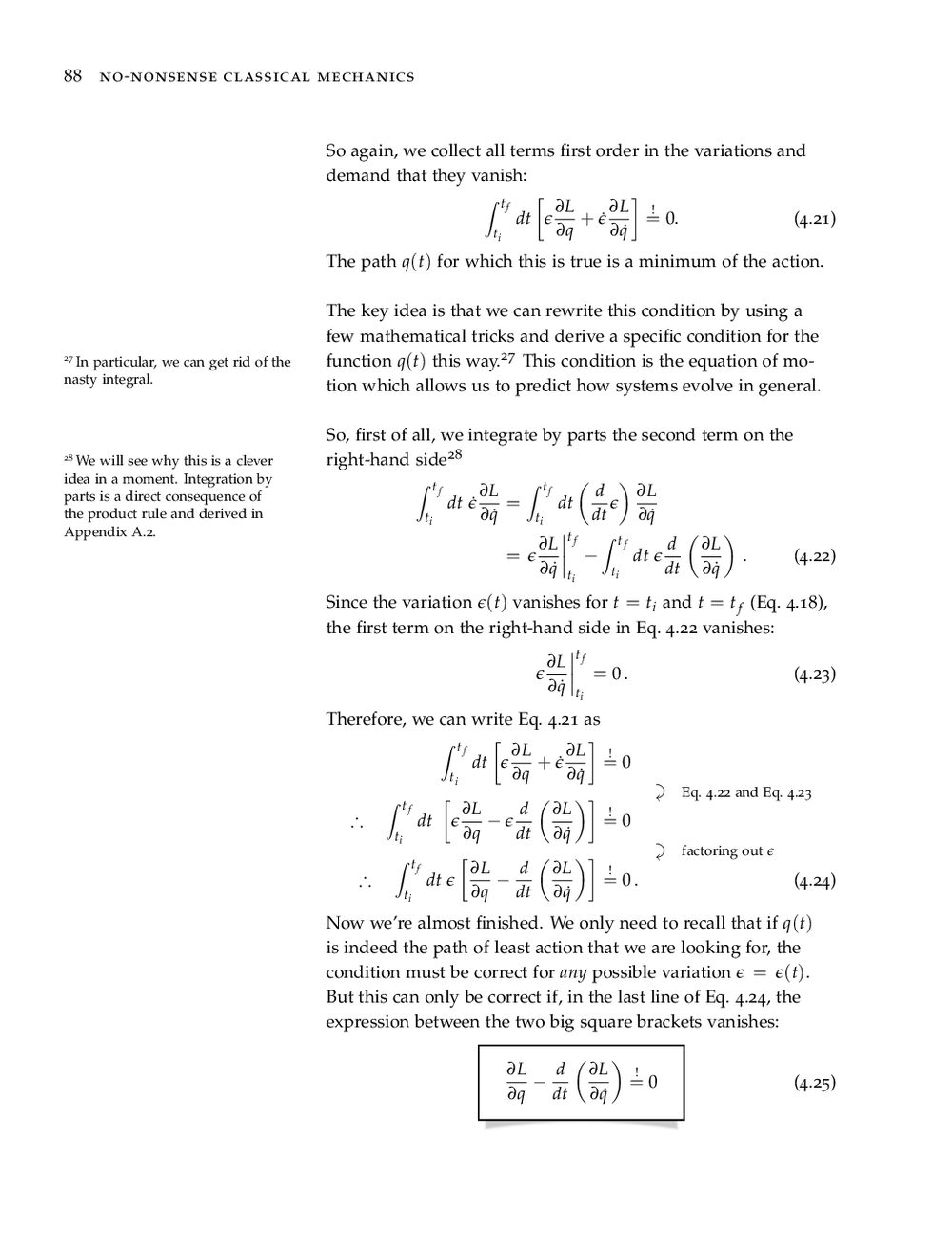
This is the core of the book and of the subject. Newtonian mechanics (p59) is short on purpose. Lagrangian mechanics (p67) starts with the principle of least action, builds the variational calculus you need (p81) and derives the Euler-Lagrange equation (p86). Hamiltonian mechanics (p93) moves to phase space, derives Hamilton's equations (p95) and then Hamilton's general equation with the Poisson bracket (p107). Chapter 6 (p113) summarises how the three connect.
Take this stage slowly. The variational calculus on p81 to p86 is new mathematics for most readers, and everything after it depends on it. Redo the derivation of the Euler-Lagrange equation on paper until you can do it without the book.
Check yourself:
- Derive the Euler-Lagrange equation from the requirement that the action is stationary.
- Explain why the Hamiltonian is the Legendre transform of the Lagrangian, and what you gain by switching from velocities to momenta.
- Write the time evolution of an arbitrary phase-space function using the Poisson bracket, and show that Hamilton's equations are special cases.
- Name one problem that is much easier in the Lagrangian formulation than in the Newtonian one, and say why.
Stage 3: systems and tools (pages 121 to 220)
Chapter 7 (p121) turns each formulation into a step-by-step algorithm: the Newtonian algorithm (p125), the Lagrangian algorithm (p127) and the Hamiltonian algorithm (p148), with tools such as choosing coordinates and using constraints. Chapters 8 and 9 then solve the harmonic oscillator (p181) and the pendulum (p201) in all three formulations, so you can compare them on the same system. Section 8.5 (p196) solves the harmonic oscillator with a canonical transformation, which is a good preview of how Hamiltonian methods work in advanced physics.
This is the stage to start working problems from a second book. See the problem sources below.
Check yourself:
- Set up the Lagrangian of a pendulum in polar coordinates and derive its equation of motion.
- Do the same for the harmonic oscillator in the Hamiltonian formulation and solve it.
- Explain why the small-angle pendulum is a harmonic oscillator.
Stage 4: understanding you can build on (pages 223 to 334)
Noether's theorem (p223) is introduced intuitively first (p228) and then proven in the Hamiltonian (p232) and Lagrangian (p242) formalisms. Chapter 11 (p251) covers three further formulations: Hamilton-Jacobi mechanics (p252), statistical mechanics (p261) and Koopman-von Neumann mechanics (p287). Chapter 12 (p295) asks where classical mechanics comes from: why the action principle works (p300) and why the Lagrangian is kinetic minus potential energy (p311), answered with quantum mechanics and special relativity.
You can skip Chapter 11 on a first read if your goal is quantum mechanics. Do not skip Noether's theorem; it comes back in every later subject, including quantum field theory, where it gives the conserved currents.
Check yourself:
- State Noether's theorem and derive momentum conservation from translation invariance.
- Explain the difference between an active and a passive transformation (Appendix E, p373) and why only one of them can be a symmetry.
- Why is L = T − V and not some other combination? Summarise the argument of Section 12.3.
Problem sources to pair with the book
No-Nonsense Classical Mechanics has worked examples but no end-of-chapter problems. Practice is still the only way to make the methods stick, so work from one of these from Stage 3 on:
- David Morin, Introduction to Classical Mechanics (Cambridge, 734 pages, $88). More than 250 problems with detailed solutions, which is what you need without a tutor to check your work. My first recommendation for self-learners.
- Louis Hand and Janet Finch, Analytical Mechanics. A student-friendly text on the Lagrangian and Hamiltonian formulations, recommended in the reading list at the end of my book.
- John R. Taylor, Classical Mechanics (786 pages, $149 list). The standard course text with many chapter problems. See Taylor compared with No-Nonsense Classical Mechanics.
After the book
- For graduate depth: Goldstein, Poole and Safko, Classical Mechanics (Pearson, 3rd edition, $279.99 list).
- For a short, dense treatment: Landau and Lifshitz, Mechanics.
- For free, compact notes at final-year level: David Tong's Classical Dynamics notes (Cambridge, about 130 pages).
- Next subject: electrodynamics, or go straight to quantum mechanics, which builds directly on Stage 2.
All of these are compared on best classical mechanics textbooks.
Common questions
Do I need Newtonian mechanics before Lagrangian mechanics?
You need the basic ideas of force, momentum and energy. The book covers Newtonian mechanics in one short chapter (p59 to p66) and then builds the Lagrangian formulation from the principle of least action, so a full Newtonian course first is not necessary.
Can I skip straight to Noether's theorem?
No. The proofs on p232 and p242 use Hamilton's general equation and the Euler-Lagrange equation from Stage 2.
Is the book enough for a university exam?
For understanding, yes. For exam technique you need practice problems, which is why I recommend pairing it with Morin or with the problem sets of your course text.